
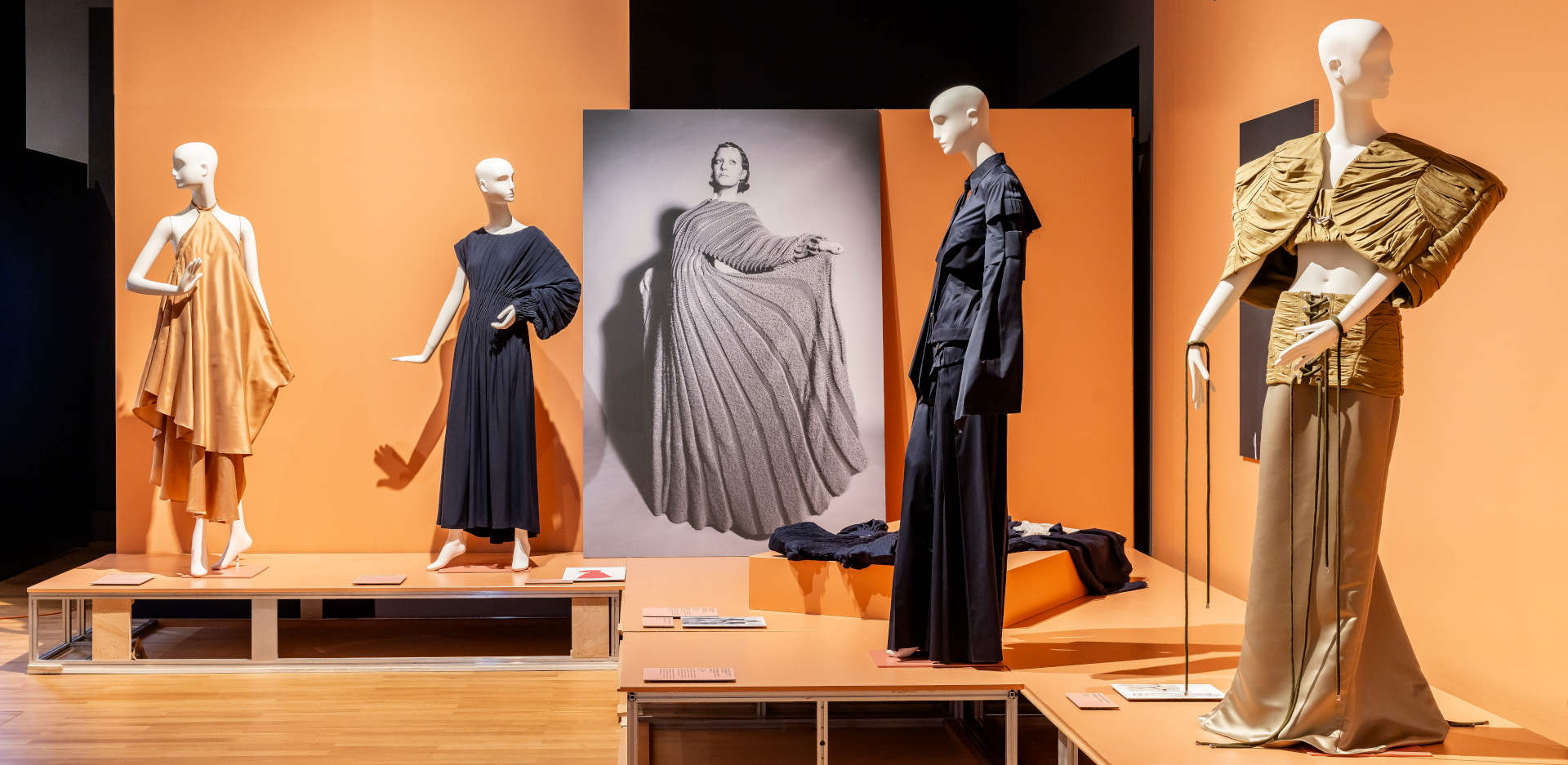
Exhibition view: “Many Shades of Grès. Fashion Becomes Art” Photo: Staatliche Museen zu Berlin, Kunstgewerbemuseum / David von Becker
A major retrospective opens this week in Berlin. It is long overdue.
She wanted to be a sculptor. Fashion, for Germaine Émilie Krebs, was never the plan. It was the compromise she made with a world that would not let a young woman from Paris simply carve stone for a living. And so she draped fabric instead, applying to the body every instinct she had developed staring at ancient Greek statuary, and in doing so became the most quietly radical designer of the twentieth century.
You know her work. You have seen it on every red carpet that has ever made you stop and stare. You have felt its logic in the collections of Rick Owens, Azzedine Alaïa, Issey Miyake, Haider Ackermann, Calvin Klein, Jil Sander, and Yohji Yamamoto, all of whom have cited her as a foundational influence. Yves Saint Laurent considered her the genius of French haute couture. Balenciaga studied her. And yet her name, Madame Grès, remains one of the best kept secrets in fashion history. A retrospective opening this week at the Kunstgewerbemuseum in Berlin, running from May 15 through October 11 (smb.museum), intends to begin correcting that.
Grès opened her first house in the 1930s under the name Mademoiselle Alix, later becoming Alix Grès, and ultimately Madame Grès, the identity under which she would spend the better part of six decades doing something that no one else in fashion was doing: treating the body as a classical form and fabric as the medium through which that form could be most honestly expressed. Her signature was the pleated gown, floor-length, constructed from dozens of meters of silk jersey folded and fixed entirely by hand directly onto a live model, without a pattern, without a sketch, as a sculptor works in clay. The finished objects did not look like dresses. They looked like the Winged Victory of Samothrace had agreed to attend a dinner party.
Her clients understood what they were receiving. Grace Kelly wore her. Marlene Dietrich. Greta Garbo. Jackie Kennedy. The Duchess of Windsor. Edith Piaf. These were women who did not need fashion to tell them who they were, and they chose Grès precisely because her clothes made no such attempt. A Grès gown does not dress its wearer. It collaborates with her.
The fashion historian and theorist Henri Bergson might have said, as scholar Becho argues in Fashion Theory, that Grès’ obsessive pleating, fold after fold, the endless repetitiveness of the gesture, creates a suspension of time. The garments exist outside of trend, outside of decade, outside of the seasonal anxiety that has driven the industry since the invention of ready-to-wear. A Grès dress from 1955 does not look vintage. It looks like it was made this morning by someone who has been alive for three thousand years.
Which is perhaps why the industry eventually turned on her. Grès refused to adapt to the ready-to-wear model that transformed Paris in the 1960s and 1970s, refused to license her name across perfume and accessories in the way her contemporaries did, refused to make herself legible to a market that wanted fashion to be fast and democratic and seasonal. Her house was forced into liquidation in 1987. She died in 1993, largely forgotten by the press, her archives scattered. It emerged only later that she had spent her final years in near poverty, her contributions unacknowledged by the industry she had shaped more than almost anyone.
The Berlin retrospective draws on the Kunstgewerbemuseum’s own collection of 25 Grès pieces, one of the largest holdings of her work outside Paris, and places them in dialogue with student designs from the Berlin University of Applied Sciences inspired by her methods. A separate retrospective at SCAD FASH in Atlanta, organized with the Fondation Azzedine Alaïa (scadfash.org), drew on Alaïa’s personal archive of Grès pieces, a collection he spent his lifetime assembling because he understood, better than anyone, that she was the source.
The definitive Rizzoli monograph on her work, edited by Olivier Saillard, remains the most complete document of what she achieved. Open it to any page and the argument makes itself. Here is a woman who worked at the level of the greatest artists of her century, in a medium the art world did not take seriously, producing objects that outlasted every trend that dismissed them.
Fashion in 2026 is in the middle of a long reckoning with craft, with permanence, with the difference between clothing that is made and clothing that is manufactured. Madame Grès never needed to reckon with any of that. She simply never stopped believing that a piece of fabric, in the right hands, was as serious as marble.
The retrospective is in Berlin. It should be everywhere.
Many Shades of Grès: Fashion Becomes Art runs May 15 through October 11, 2026 at the Kunstgewerbemuseum, Berlin. smb.museum