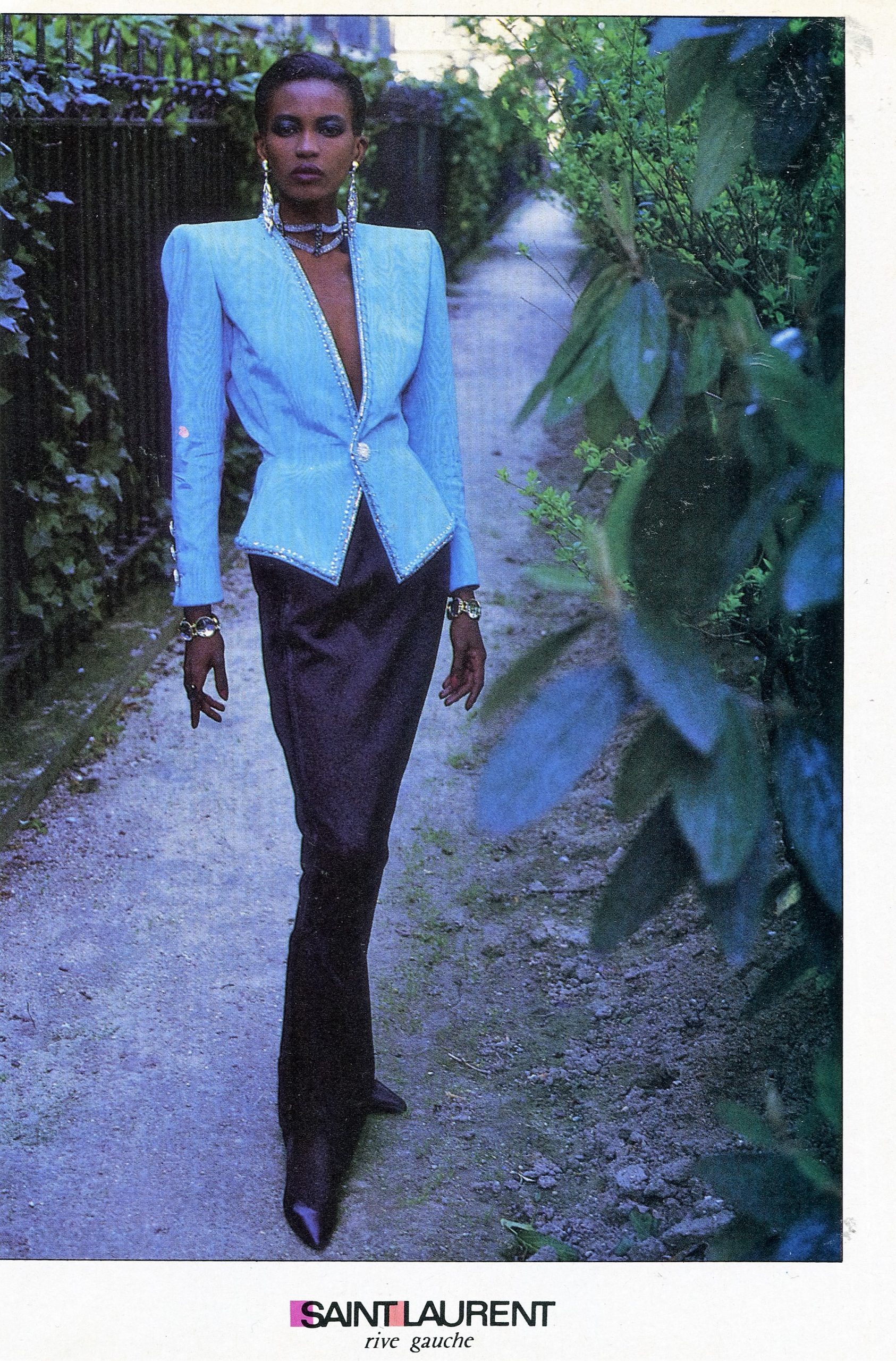
1985 Yves Saint Laurent Rive Gauche campaign photographed by Helmut Newton
Fashion is rediscovering its oldest and most radical idea. That a garment, truly made, is not a purchase. It is a promise.
There is a jacket hanging in someone’s closet right now that belonged to their grandmother. Black. Double-breasted. Shoulders built like architecture. The kind of jacket that does not ask for attention but commands it the moment it enters a room. It was made in a time when clothing was not seasonal inventory but a considered act of making, something that would absorb decades of living and emerge more beautiful for it. You have seen this jacket before. You have felt it. It is the jacket in the Saint Laurent Rive Gauche campaign from the 1980s, the one with the hands on the hips and the beret and the absolute refusal to apologise for taking up space. That jacket is not a relic of another era. It is the most advanced fashion concept of 2026.
The industry is remembering something it deliberately forgot. For thirty years, the logic of fast fashion insisted that clothing was disposable, that its value was in its newness and its price was in its brevity. The consequences of that logic are now undeniable. The fashion industry is responsible for approximately 10 percent of global carbon emissions, more than all international flights and maritime shipping combined (earth.org/the-environmental-impacts-of-fast-fashion), and generates an estimated 92 million tonnes of textile waste every year. Against this backdrop, a counter-movement has emerged, one that is not simply about making fashion more ethical but about making it more meaningful. About returning to the oldest definition of a great piece of clothing: something worth keeping. Something worth passing on.
The Psychology of the Object That Lasts
Before we can understand why heirloom fashion is having its cultural moment, we have to understand why human beings form attachments to clothing in the first place, and what those attachments actually do to us.
Research by Masuch and Hefferon, published in 2018, proposed that what they termed “dress memorabilia” functions as a memory-storage complex, reinforcing self-continuity in ways that photographs or souvenirs cannot replicate (phys.org/news/2025-12-treasure-emotional-style-lot-sustainable). A photograph documents a moment. A garment lived through it. It moved with your body. It absorbed the season, the emotion, the gesture. It holds not just memory but presence. Psychological research by Professor Kiara Timpano and researcher Jamie Port, published in 2020, further established that emotional attachment to meaningful objects is not regression but regulation: a sophisticated psychological mechanism by which we maintain a stable sense of self across time.
Swedish professor Otto von Busch, in his foundational work The Psychopolitics of Fashion (bloomsbury.com/us/psychopolitics-of-fashion-9781350099784), argues that clothing functions as a psychological tool through which people express identity, negotiate belonging, and make sense of who they are in the world. When we inherit a garment, we are not just receiving a physical object. We are receiving a piece of someone’s constructed self, and integrating it into our own.
Psychologist Christian Jarrett has written extensively about what he calls “associative valuation,” the phenomenon by which objects become imbued with the perceived essence of their previous owners (mdash.mmlafleur.com/why-we-become-emotionally-attached-to-certain-clothes). A study by Lia Godoy Fuster and colleagues on heirloom coats and jackets found that such garments carry what the researchers describe as “relics associated with an emotional value” that transcends their physical properties. This is not sentimentality. This is the deepest form of luxury there is: an object so charged with meaning that it becomes irreplaceable.
Research published in Anthropology News (anthropology-news.org/articles/an-ethnography-of-textile-preservation-caring-for-the-wardrobe-of-a-missing-person) documents what grief scholars now call “continuing bonds,” the practice of bereaved individuals preserving the clothing of those they have lost as a way of maintaining connection across death itself. Clothing, in this framework, is not just a record of a life. It is an extension of one.
The Economics of Permanence
The market has begun to reflect what psychology has long understood. The second-hand luxury market, once considered an alternative economy operating at the margins of fashion, is now one of its fastest-growing segments. According to The State of Fashion 2026 (businessoffashion.com/reports/news-analysis/state-of-fashion-2026), resale is projected to reach 350 billion dollars by 2028, growing two to three times faster than traditional retail. The luxury resale market specifically is expanding at 12 percent annually compared to 3 percent for the primary market, a divergence that tells you everything about where consumer values are moving.
The most compelling evidence of the heirloom principle in economic action is Hermès. The house, founded in 1837 as a saddle-making workshop, has never deviated from a single conviction: that an object made to the highest possible standard, from the finest possible materials, using techniques refined over centuries, will outlast everything around it. A single Hermès bag can take up to 18 hours to construct, stitched by hand using century-old saddle techniques that produce a seam no machine can replicate (miloura.com/blogs/news/why-hermes-bags-hold-their-value-better-than-any-other-luxury-brand). The result is extraordinary: Hermès bags retain up to 90 percent of their value on the resale market, and certain Birkins appreciate up to 120 percent above their original retail price. These are not fashion accessories. They are assets. They are things people fight over in wills.
Chanel occupies a parallel position, with the Classic Flap and the 2.55 maintaining consistent resale value across generations of ownership. “Chanel is unique in that it resonates across generations,” Ivan Todorov, founder of Libas Collective, told Markets Herald (marketsherald.com/collectible-couture-understanding-the-resale-appeal-of-chanel-hermes-and-louis-vuitton-classics). “Collectible couture is the opposite of fast fashion. It’s about longevity, sustainability and heritage.” Vestiaire Collective (vestiairecollective.com), one of the leading pre-owned luxury platforms globally, has understood this instinctively. Their positioning of pre-owned luxury not as compromise but as connoisseurship has shifted the cultural conversation entirely. A vintage Kelly from the 1980s is not a lesser object than a new one. It is a more interesting one.
Pandora offers a different but equally instructive case. The Danish jewellery house committed in 2024 to sourcing 100 percent recycled silver and gold across all of its pieces (pandora.net/en-us/sustainability), and has seen a 45 percent revenue increase since 2019 as a result (corporateknights.com/circular-economy/these-big-retail-brands-are-rallying-around-circular-fashion). The lesson is clear: consumers are not sacrificing desire for ethics. They are finding that the most desirable things are also the most responsible ones.
The Materials of the Next Generation
The heirloom philosophy is not limited to existing luxury goods. A new generation of material innovators is building the heirlooms of the future from entirely new foundations.
Mycelium leather, grown from mushroom root networks, has moved from experimental to commercial scale, offering a material that is not only biodegradable but develops character with age in ways synthetic alternatives cannot. Fabrics derived from algae, apple skin, and other bio-based sources are entering production across Europe and North America, evaluated not just for their environmental credentials but for their narrative potential: materials with a story, a provenance, a reason to exist.
Everbloom (fastcompany.com/91497207/fashion-apparel-most-innovative-companies-2026) represents perhaps the most practically significant development in this space. The company has developed a process for regenerating wool and cashmere that integrates directly into existing industrial mills, allowing heritage textile producers to adopt the technology without rebuilding their infrastructure. In doing so, Everbloom is not disrupting the tradition of fine wool. It is extending it, making the materials associated with the most enduring garments in fashion history more sustainable without sacrificing the qualities that made them worth preserving in the first place.
The EU Digital Product Passport, coming into mandatory effect for textiles in 2027 (ec.europa.eu/growth/sectors/textiles), will for the first time require brands to provide complete traceability for every garment: where it was made, what it contains, how it can be cared for, repaired, and ultimately recycled. This is provenance as legislation. A garment that cannot account for itself will increasingly have nowhere to go.
The Designers Building for Generations
The most interesting fashion being made right now is being made by people who think in decades rather than seasons.
Stella McCartney (stellamccartney.com) has built her entire practice around the rejection of disposability, using mycelium, recycled nylon, and innovative bio-based materials to create pieces intended to outlast their moment. Marine Serre (marineserre.com) works extensively with upcycled and deadstock fabrics, producing collections where every piece has a documented origin and a considered future. Patou (patou.com), revived under creative director Guillaume Henry, has returned the house to its founding philosophy of quality over quantity, with short supply chains and artisan craftsmanship that produces garments explicitly designed to be worn for years and then passed on. The Global Fashion Agenda’s 2026 Recycle the Runway programme (globalfashionagenda.org/news-article/introducing-the-recycle-the-runway-2026-winners) recognised designers building practices around what winner Laura O’Neill described as “intentional ownership”: garments created to be lived in, repaired, maintained, and eventually handed to someone else.
Jenni Kayne (jennikaynes.com) has built her California brand around what the company describes as “effortless, enduring style,” pieces designed to grow more beloved with time, rooted in natural fibers and ethical production. Sézane (sezane.com), the French label that has become one of the most talked-about brands of the decade, has built a community around exactly this philosophy: clothes that feel personal, that feel considered, that feel like they belong to you rather than to a trend cycle.
What We Are Really Choosing
Researchers studying emotional attachment to clothing have identified something that the industry has been slow to acknowledge: that it takes time for a garment to become meaningful (plantedjournal.com/why-do-we-get-emotionally-attached-to-clothes-a-contrast-to-fast-fashion). Typically more than a year of regular wear before the memories weave themselves into the fabric, before the leather softens in exactly the right places, before the wool takes on the particular warmth of a specific winter. Fast fashion, by design, does not allow for this. It arrives already obsolete. Heirloom fashion, by design, requires it.
The practice that sustainability researchers are now calling “generational garment passing” (lifestyle.sustainability-directory.com/area/generational-garment-passing) is not new. It is the oldest relationship human beings have ever had with clothing. What is new is that it is being recognised as both the most sustainable and the most meaningful approach to dressing, simultaneously. The most environmentally responsible wardrobe is one where everything has a reason to be there. The most personally resonant wardrobe is exactly the same one.
Fashion has always been about desire. What is shifting, quietly and irreversibly, is the nature of that desire. We are learning to want things that will still be beautiful in thirty years. Things that carry a story. Things we might one day press into the hands of someone we love and say: this was mine. Now it is yours.
That jacket in the closet did not survive because it was fashionable. It survived because it was worth surviving.
Sources: The State of Fashion 2026 (businessoffashion.com), Fast Company Most Innovative Companies 2026 (fastcompany.com), EU Digital Product Passport (ec.europa.eu), Masuch and Hefferon dress memorabilia research via phys.org, Otto von Busch The Psychopolitics of Fashion (bloomsbury.com), Anthropology News textile preservation study (anthropology-news.org), Planted Journal emotional attachment research (plantedjournal.com), Sustainability Directory generational garment passing (sustainability-directory.com), Miloura Hermès resale report (miloura.com), Corporate Knights circular fashion report (corporateknights.com), Markets Herald collectible couture (marketsherald.com), Global Fashion Agenda Recycle the Runway 2026 (globalfashionagenda.org).