The most powerful luxury brands in the world are no longer satisfied with dressing you. They want to be the room you sleep in.
Something has shifted in the ambitions of fashion. Not gradually, not tentatively, but with the kind of decisive confidence that suggests the industry has made a decision it does not intend to reverse. The luxury fashion house, for most of the twentieth century the most self-contained of cultural institutions, has decided that a wardrobe is no longer enough. It wants your breakfast. It wants your view. It wants to be the light coming through your window in the morning and the thread count of the sheets you slide into at night.
The most quietly extraordinary example of this is not a grand hotel on a famous boulevard. It is a thirteen room boutique in the village of Melides, on Portugal’s Alentejo coast, designed entirely by Christian Louboutin. Vermelho, named after the Portuguese word for red and a direct nod to the house’s lacquered signature sole, began as an accident. Louboutin discovered Melides while traveling in the region decades ago, bought a fisherman’s shack, then a home, then an atelier, then another building he intended to turn into a restaurant. The town’s mayor suggested a hotel instead. The result is one of the most personal and specific objects in contemporary hospitality: a building Louboutin described as being like a gold bangle he once showed his architect, simple and restrained on the outside, and on the inside an explosion of hand-painted frescoes by Greek artist Konstantin Kakanias, red tile floors from the Fábrica de Azulejos de Azeitão, chandeliers of blown glass by India’s Klove Studio, rattan chairs from the Maison Gatti archives dating to the nineteenth century, and antiques from Louboutin’s personal collection accumulated over a lifetime of looking. “This project allowed me to empty my storage full of antiques and objects I have purchased over the years,” he said. No two rooms are the same. The hotel has since expanded with two new villas nearby, one kasbah-inspired and designed in collaboration with Egyptian designer Tarek Shamma, the other a whitewashed boathouse with shell-cluster lamps and miniature boats pinned to the walls.
Vermelho is the most intimate expression of what fashion is reaching for. But it is far from alone. Louis Vuitton is opening its first hotel on the Champs Élysées this year, at 103 Champs Élysées, a 6,000 square metre property whose facade has been designed to reference the house’s iconic trunk. The entire building is a piece of luggage you can live inside. Bulgari has been quietly building a hotel empire for years, with properties in Milan, London, Dubai, Paris, Tokyo, and Rome that operate less like hotels and more like three-dimensional manifestations of the house’s particular understanding of beauty. Palazzo Versace opened in Macau in 2024, 271 rooms styled in the house’s unmistakable visual language, every surface a statement. Giorgio Armani has had hotels for years, almost unremarked upon, because they feel so entirely consistent with everything else the house makes that their existence seems inevitable.
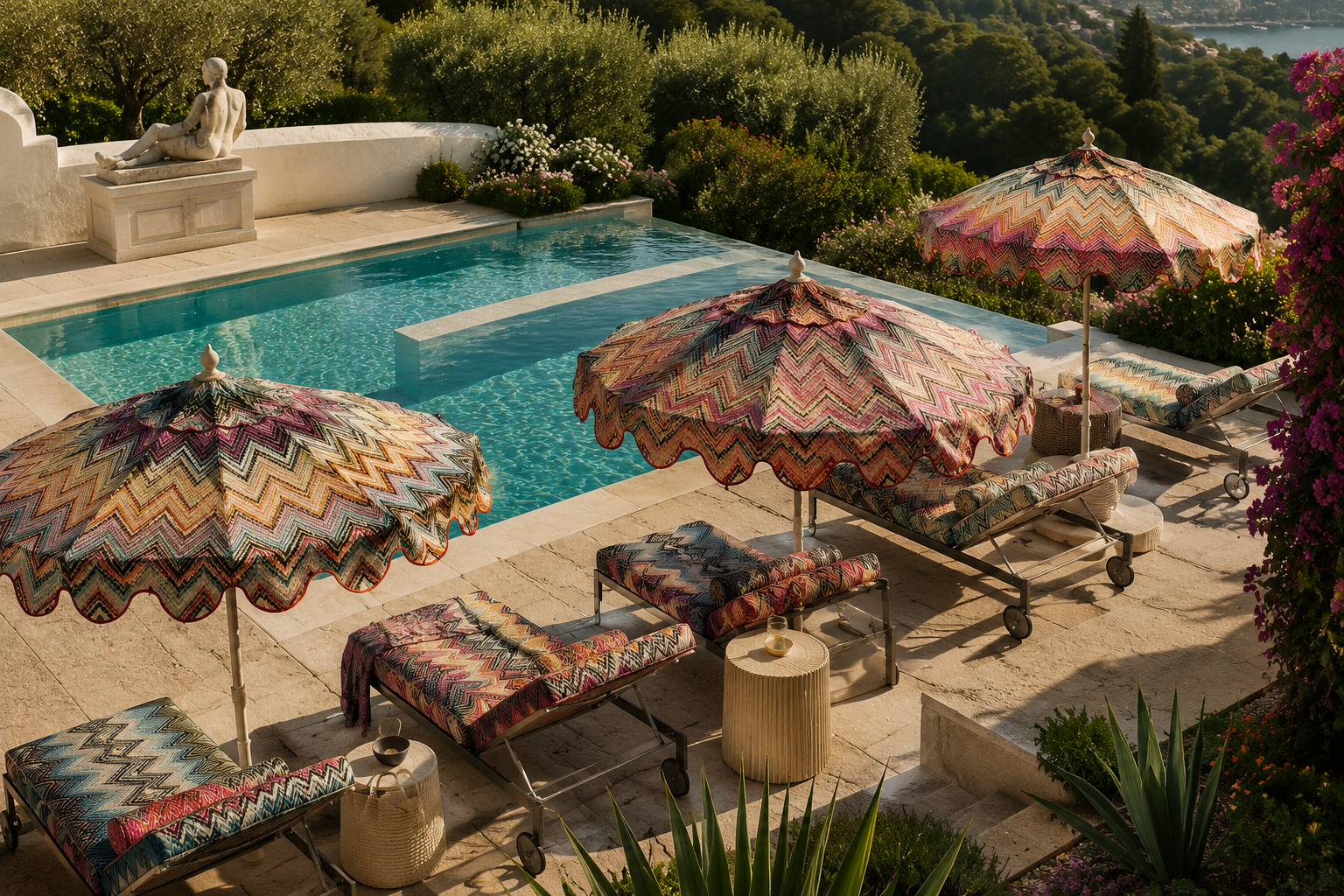
The pop-up model, meanwhile, has become one of the industry’s most quietly powerful strategies. Dior has a summer residency at The Little Nell in Aspen and Dior-branded buoys floating off the coast of Capri. This summer the house partnered with Belmond for a four-day wellness journey aboard the Royal Scotsman train through the Scottish Highlands, a moving hotel dressed entirely in the Dior universe. Dolce and Gabbana wrapped the pool deck of the Four Seasons San Domenico Palace in Taormina in cobalt-blue floral lounge liners that generated more coverage than most runway shows. Missoni has stretched its bold stripes across pool decks in Ibiza and Mykonos. Balmain, Guerlain, and Valentino have partnerships running across the Mediterranean this summer alone.
The question worth asking is not what these brands are doing. It is why they are doing it now, and what it tells us about where luxury is actually going.
The most obvious answer is the experience economy, the well-documented shift in consumer behaviour away from objects and toward moments. But that explanation, while accurate, is insufficient. What these brands are pursuing is something more ambitious and more interesting than a diversified revenue stream. They are pursuing total immersion. A bag can be copied. A dress can be knocked off within weeks of a runway show. But the specific feeling of waking up in a Bulgari hotel in Milan, of swimming off a Dior-branded coast, of having the thread count and the scent and the light and the breakfast all speak the same language as the jacket hanging in your wardrobe, that is something that cannot be counterfeited. The experience is the product, and the product is the experience, and the two have become indistinguishable.
There is also a more fundamental logic at work. The luxury boutique has been quietly evolving for a decade into something that no longer resembles a shop. The most significant retail spaces in fashion right now, from the Loewe flagship in Paris to the Prada Epicenter in New York designed by Rem Koolhaas, are environments that ask you to inhabit them rather than simply browse them. The hotel is the natural endpoint of that logic. If the store is already an experience, and the experience is already a kind of living, then the next step is simply to make it possible to stay.
What Louboutin understood instinctively in Melides is what the entire industry is now racing to replicate at scale. The most powerful thing a brand can offer is not a product you take home. It is a world you never want to leave.