Every September, the world’s most beautiful people fly to a sinking city to watch movies in a room named after Mussolini’s finance minister. Nobody talks about that part. They should, because the Venice Film Festival’s origin story is stranger, darker, and more fascinating than anything premiering on its red carpet this year.
With the 2026 edition set to open September 2nd (Alberto Barbera back at the helm, Robert Pattinson returning for the first time since 2019, Penélope Cruz and Javier Bardem headlining Florian Zeller’s “Bunker,” Maggie Gyllenhaal presiding as jury president), it’s worth knowing what you’re actually looking at when you see that Golden Lion trophy. It has a past. Let’s get into it.
An Invention of Propaganda, Dressed as Art
Venice didn’t invent the film festival because someone loved cinema. It invented the film festival because Italy was annoyed.
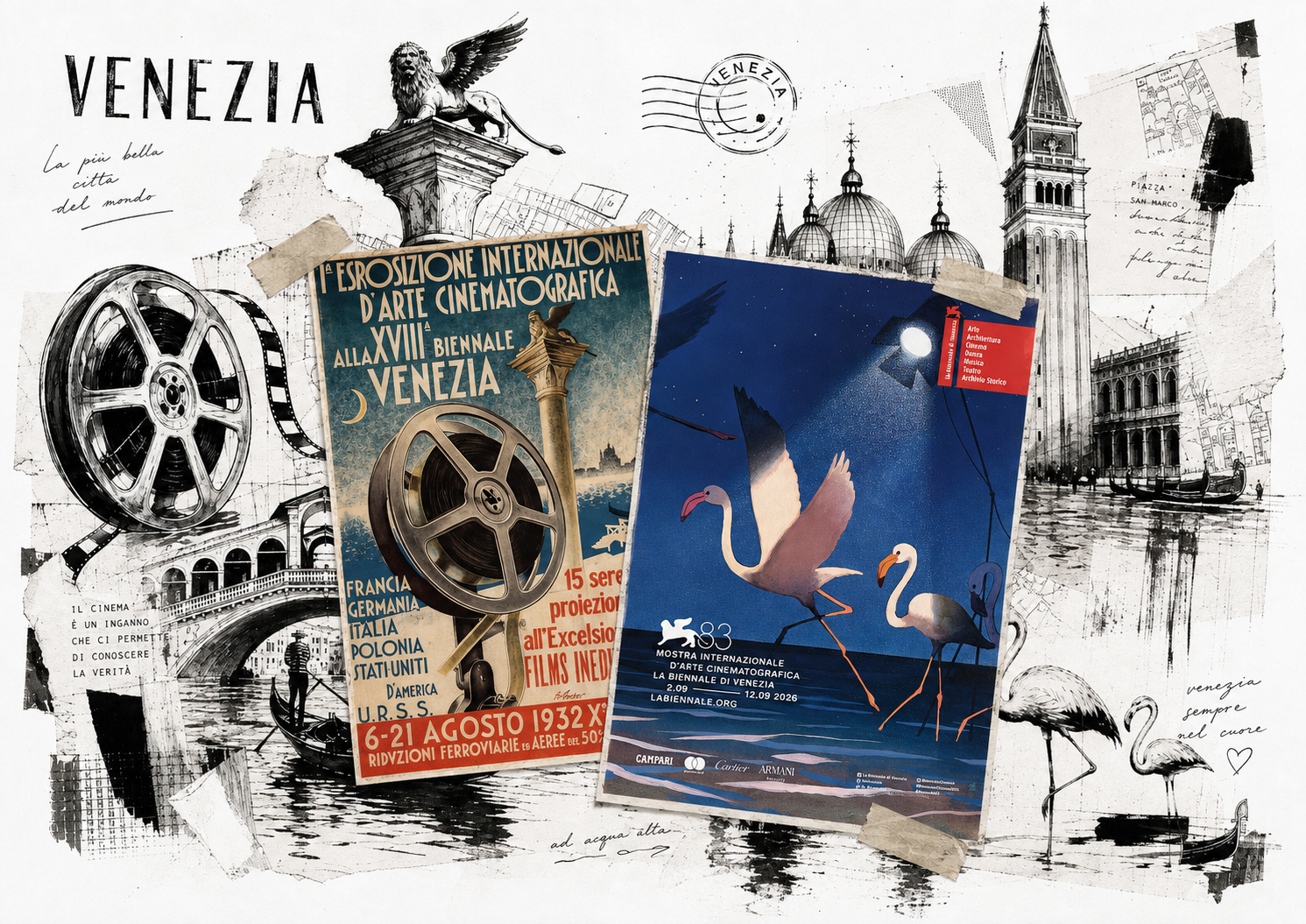
In 1932, most films screening in Italian theaters were American. Giuseppe Volpi di Misurata, a shipping magnate, colonial administrator, and Mussolini’s own finance minister, decided Italy needed a stage of its own. He folded a film showcase into the Venice Biennale, the city’s existing art exhibition, and on August 6, 1932, on the open air terrace of the Hotel Excelsior on the Lido, roughly 25,000 spectators watched Rouben Mamoulian’s “Dr. Jekyll and Mr. Hyde” flicker against the Adriatic sky. Greta Garbo and Clark Gable were among the era’s biggest names associated with that first slate. There was no jury. Winners were decided by audience applause, cinema’s first popularity contest dressed up as high culture.
It worked. By 1934 the festival had a real competitive structure and a trophy with a name that has aged, to put it mildly, poorly: the Coppa Mussolini, the Mussolini Cup, handed out for the best Italian and foreign films. Roughly nineteen countries showed up. Two years later it went annual. In 1937, the festival got its permanent home, the Palazzo del Cinema, essentially the same building that hosts it today.
The Nazi Years, and the Festival That Nearly Died
Here’s the part that doesn’t make it into the glossy retrospectives: by 1940, as fascist Italy tightened its grip on cultural institutions, Venice was rebranded the Italo-German Film Festival. Nazi propaganda pictures screened in competition. Prizes went to films now remembered, when they’re remembered at all, as instruments of a regime.
It’s not a coincidence that Cannes exists. France conceived its own festival in 1939 explicitly as a democratic answer to Venice’s fascist capture, a “festival of the free world,” as one of its founders put it. World War II delayed Cannes’ actual launch until 1946, but the rivalry between Europe’s two great film festivals was born, quite literally, out of one filmmaker’s discomfort with the other’s politics. Venice, meanwhile, effectively went dark: 1940 through 1942 are considered non-editions, held under bombing threats outside the city, and the festival didn’t return in any real form until the war ended.
The Comeback, the Golden Lion, and a Decade of Total Collapse
Venice reopened in 1946 in the ruins of postwar Europe, and the 1947 edition, staged in the courtyard of the Doge’s Palace, pulled a staggering 90,000 attendees, a record that signaled the festival’s cultural resurrection. In 1949, the festival finally severed itself from its fascist branding for good: the Golden Lion of St. Mark, modeled on the winged lion that’s been Venice’s symbol since the Republic, replaced the discredited Mussolini Cup. It remains the top prize today.
Then came 1968. Student protests and a broader wave of European political upheaval hit the festival hard, and what followed was almost a decade of institutional collapse: from 1969 to 1979, Venice awarded no prizes at all. It became non-competitive by design, essentially reverting to its 1932 audience vote model because the establishment version of “prestige” had become politically toxic. The festival wasn’t even held in 1973, 1977, or 1978. It took director Carlo Lizzani, who supervised the festival for four editions starting in 1979, to rebuild it. The Golden Lion officially made its comeback in 1980, alongside the expert selection committees that still shape the lineup today.
The Facts to Actually Bring to Dinner
A few things worth knowing that most red carpet coverage skips entirely: the festival’s acting prize, the Volpi Cup, predates the Golden Lion by fifteen years and is still considered the more prestigious of the two by many actors, since it’s a straight recognition of performance rather than a film’s overall package. Japanese cinema’s entire entry into Western consciousness arguably runs through Venice. Akira Kurosawa’s “Rashomon” won the Golden Lion in 1951 and effectively introduced Japanese filmmaking to international audiences overnight; Kenji Mizoguchi won recognition at Venice three years running not long after. And the festival that now feels synonymous with couture gowns and paparazzi scrums spent its first year with no formal jury whatsoever. The entire outcome rode on how loudly a few thousand people clapped on a hotel terrace.
How a Fascist Trade Show Became the World’s Stage
That’s the part that makes Venice’s evolution genuinely remarkable: an event built by one authoritarian government, as a nationalist showcase, is now the place where the global film industry effectively opens its year. The turning point was less a single moment than a slow, decades long widening. Every crisis (the wartime shutdown, the 1969 to 1979 collapse) forced Venice to rebuild itself as something less insular and more international than what came before, first around expert selection committees, then around an increasingly global slate of directors and stars.
Under Alberto Barbera (who first ran the festival from 1998 to 2002, then returned as artistic director in December 2011 and has since been repeatedly renewed, most recently through 2028) that widening became the whole identity of the festival. “Gravity,” “Birdman,” “La La Land,” “Nomadland,” and “Dune” all launched or premiered there before sweeping into the international awards conversation. In 2018, Alfonso Cuarón’s “Roma” became the first Netflix film to win the Golden Lion at a major festival, a genuinely seismic moment that forced the entire industry, worldwide, to reckon with what “cinema” even meant in the streaming era. A year earlier, in 2017, Venice became the first major festival to program a virtual reality section, now called Venice Immersive, proof that a nearly century old institution could still set the pace rather than follow it.
Ninety four years after a few thousand people clapped for a monster movie on a hotel terrace, Venice now draws filmmakers, distributors, and press from every continent, and functions as one of the three festivals (alongside Cannes and Berlin) that effectively set the tone for a year in film worldwide. It didn’t start as an international platform. It became one, deliberately, one rebuild at a time.