 Photo Credit: P.Taufiq Photography
At New York Fashion Week, Shivangi Gupta Singh and Shashank Gupta turned temples, mythology, poetry and family memories into a runway filled with color, craftsmanship and meaning.
There was something almost cinematic about Nazranaa’s presentation at New York Fashion Week. For its SS27 collection, Samskriti 2.0, the South Asian fashion house transformed Refectory Chelsea into a celebration of everything that makes Indian culture so endlessly inspiring from sacred architecture and mythology to poetry, mathematics and generations-old family stories.
Rather than looking backward, the sibling design duo Shivangi Gupta Singh and Shashank Gupta approached heritage with a distinctly modern eye. The result was couture that felt romantic, intricate and deeply personal, while still belonging completely to the New York fashion landscape.
A Runway Full of Stories
Everywhere you looked, there was another reference waiting to be discovered.
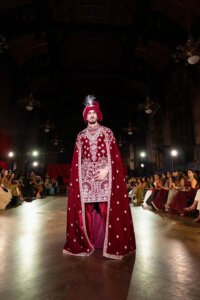
The collection drew inspiration from the Meenakshi Temple, Prem Mandir, Jagannath Puri Rath Yatra, Holi and Raas Leela, translating their colors, forms and symbolism into elaborate silhouettes and embroidery.
But perhaps the most beautiful references were the ones connected to the designers themselves. A Vrindavan-inspired look reflected Shivangi’s childhood connection to Mathura and Vrindavan, where her mother was born and where she grew up surrounded by stories of Radha and Krishna.
It made the collection feel less like an archive and more like a memory you could wear.
Couture Has a Brain, Too
Samskriti 2.0 also reminded us that inspiration doesn’t always have to come from the obvious places.
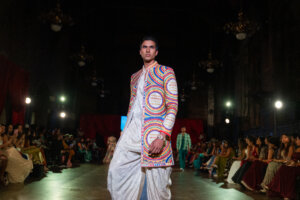
Two menswear jackets looked toward India’s intellectual history. One translated Acharya Pingala’s Meru Prastara into a graphic composition using Laghu, Guru, 1 and 0, while another transformed Sanskrit poet Māgha’s Sarvatobhadra into a reversible geometric pattern.
It’s an unexpectedly cool idea: taking concepts that traditionally live inside books and turning them into something you can actually put on.
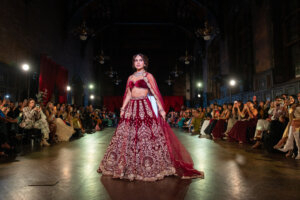
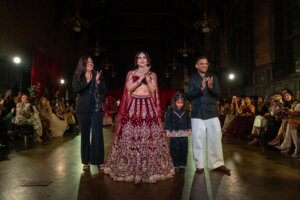
On the picture: Bhumi Satish Pednekkar
The Final Look Belonged to Bhumi
Then came Bhumi Pednekar.
The Bollywood actor closed the show in a hand-embroidered velvet lehenga inspired by the Ramakrishna Temple at Belur Math. The design featured a swan representing the Paramatman, or Supreme Self, at the center of the skirt, while scalloped lotus details finished the veil.
The symbolism was just as important as the spectacle. Belur Math’s architecture incorporates elements inspired by Hindu temples, mosques and churches, reflecting an idea of unity and beauty in diversity.
On the New York runway, that message became one of the evening’s most memorable fashion moments.
 More Than a Fashion Show
What Nazranaa presented wasn’t simply a collection of beautiful lehengas and couture pieces. It was a reminder that cultural fashion can be both deeply rooted and completely current.
Samskriti 2.0 takes stories that have existed for centuries and gives them a new vocabulary one made of embroidery, velvet, movement, geometry and glamour.
And with Bhumi Pednekar closing the show, Nazranaa gave New York Fashion Week a finale that felt appropriately grand: a little Bollywood, a lot of couture, and an entire culture stitched into every detail.