Image illustration by Stéphane Marquet
From the ateliers of Casablanca to the runways of Paris, the influence runs deeper than fashion has ever fully said.
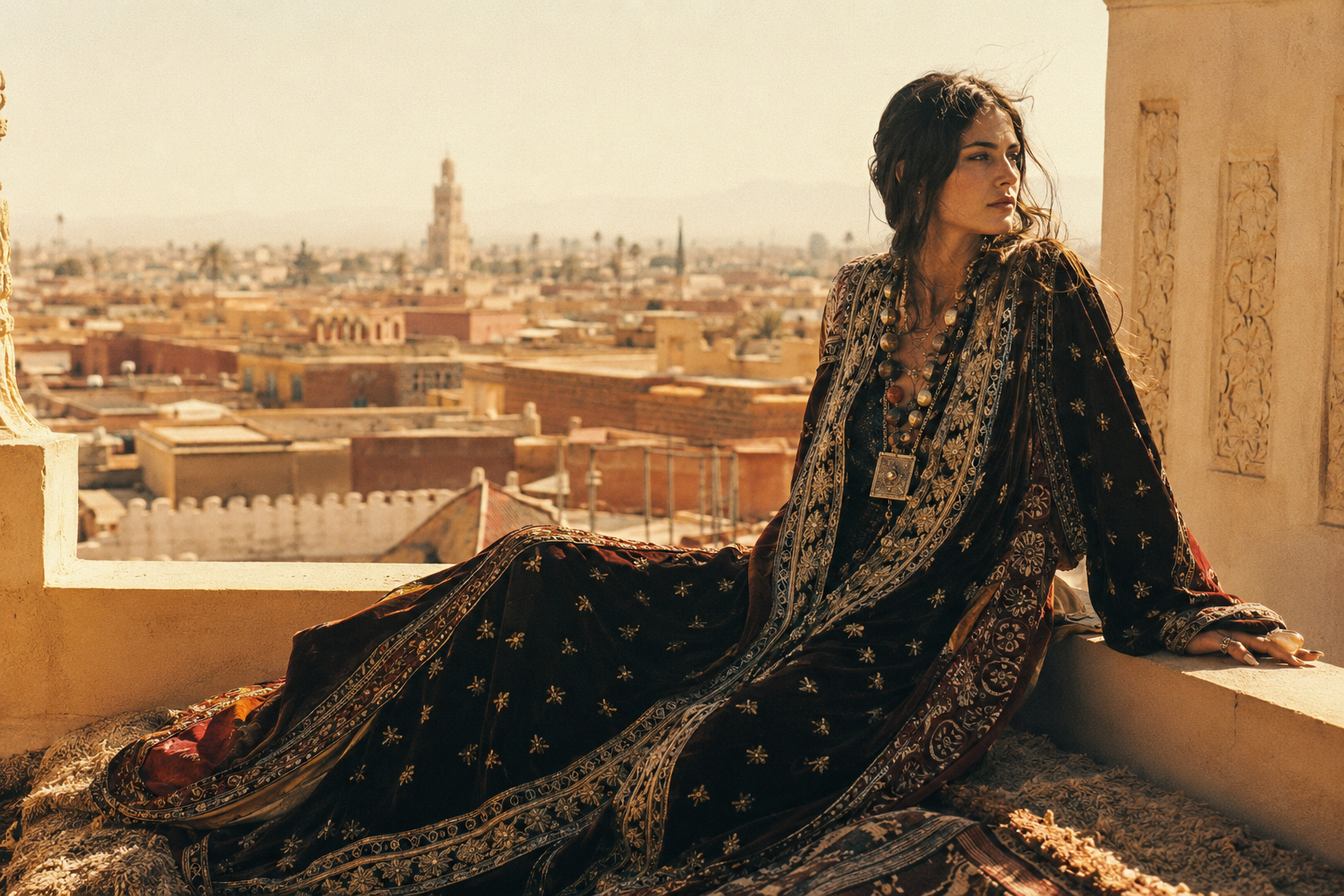
In 1970, Vogue published a photograph that has never stopped being referenced. Talitha Getty, draped in embroidered robes on a Marrakesh rooftop, the city spreading gold and ochre behind her, the light doing what Moroccan light has always done to fabric and skin. The image was not styled in the conventional sense. It was simply true. And it changed, in ways the fashion world has never fully mapped, the visual language of luxury for the next half century.
Morocco has always been to Paris what the unconscious is to the dream: the source of the most powerful images, quietly present in everything.
The relationship between Moroccan craft and French haute couture is not a story of inspiration in the vague, decorative sense the fashion industry typically uses that word. It is a story of specific techniques, specific objects, and specific people whose contributions have woven themselves into the vocabulary of luxury in ways that deserve to be seen clearly. The caftan alone is a case study in the depth of this exchange. Originating in the medieval Moorish courts, refined through centuries of Berber, Arab, and Andalusian tradition, worn by the women of the French aristocracy as early as the 18th century, it arrived in the formal vocabulary of haute couture through a very specific moment: Christian Dior, in the late 1950s, designed a black silk satin caftan. Yves Saint Laurent followed with his own version, belted. And from there the garment moved through the collections of nearly every major house of the 1960s and 1970s, photographed by Irving Penn and Helmut Newton for the pages of Vogue, carrying with it a centuries-old Moroccan craft tradition that had simply always been there.
The story of Dior and Morocco runs deeper than most people know. In the 1950s, the Casablanca fashion house Joste entered into a formal partnership with Christian Dior to create exclusive collections for Moroccan clientele, a collaboration that continued until the 1980s, well beyond the death of Monsieur Dior himself in 1957. The partnership gave Dior direct access to the finest Moroccan craftsmanship of the era and gave Casablanca’s fashion world its most significant international connection. In the 1970s, Moroccan couturière Tamy Tazi, a close friend of Yves Saint Laurent, took over Joste and became one of the most important designers working anywhere in the world, reviving the caftan’s creative possibilities at precisely the moment that Western fashion was most hungrily consuming Moroccan aesthetics.
Saint Laurent’s relationship with Morocco is the most documented of these exchanges. He arrived in Marrakesh in 1966 and it altered everything: his palette, his relationship to embroidery and surface, his understanding of what colour could do in a garment. The famous 1976 Opera Ballet Russe collection, widely considered one of the greatest in fashion history, drew directly on the colours, textures, and craft traditions he had spent a decade absorbing in the country. It is a collection that every fashion student studies. The Moroccan thread running through it is part of what makes it extraordinary.
The women who were building a genuinely Moroccan haute couture in the same period deserve their own chapter in that history. The Victoria and Albert Museum has documented the work of Zina Guessous, Naima Bennis, Zhor Sebti, and Tamy Tazi, the first generation of Moroccan fashion designers who emerged from Casablanca in the 1960s, confronting simultaneously the aftermath of the French Protectorate and the pressures of a rapidly modernising society. These women dressed Jackie Kennedy. They dressed Talitha Getty. They dressed Catherine Deneuve. Diana Vreeland wrote about them extensively in the pages of American Vogue. Their contribution was precise and extraordinary: they modernised Moroccan fashion by introducing the fluid fabrics and cleaner silhouettes of European couture while insisting on the primacy of Moroccan craft, the handwork, the regional embroidery traditions, the local techniques passed through generations of artisans in Fez and Marrakesh and the Atlas villages. They did not choose between tradition and modernity. They insisted on both.
The craft traditions they drew on are among the most sophisticated in the world. The silk and sabra textiles of Fez, sabra being a plant-based silk derived from the agave cactus, carry a sheen and durability that no synthetic has ever replicated. The natural dyeing techniques of Moroccan artisans, using plant-based pigments refined over centuries, produce colours that exist nowhere else in the textile world. The embroidery traditions vary by region, each carrying its own visual grammar and its own form of accumulated knowledge. These are not decorative traditions. They are intellectual ones.
The current moment in fashion, with its deep hunger for craft, for permanence, for the difference between something made and something manufactured, returns again and again to these traditions. And there are signs of a more complete conversation beginning to take shape. Sara Chraïbi, a Moroccan designer and architect, joined the French Federation of Haute Couture in 2022 and now presents at Paris Haute Couture Week, her work blending Moroccan craft heritage with contemporary couture structure. Mohamed Benchellal, a Dutch-Moroccan couturier who won the Vogue Arabia Fashion Prize in 2020, has built a practice around sustainable fashion that integrates Moroccan craftsmanship with sculptural European tailoring and has dressed Sharon Stone, Billy Porter, and Alicia Keys. Maison ARTC, founded by Artsi Ifrach in Marrakesh, repurposes vintage garments in ways that merge North African cultural identity with a fashion intelligence that belongs to no single tradition.
These designers are not translating Morocco for an outside audience. They are continuing a conversation that has always been happening, in the ateliers of Casablanca, on the rooftops of Marrakesh, in the souks of Fez where the dyers still work in the same vats they have always used, producing the same colours that have always found their way, eventually, onto the most beautiful things fashion has ever made.