By Joseph Dixon
Europe’s first legal public gaming room opened in Venice in 1638, in a wing of the Palazzo Dandolo, and its dress code makes every modern one look slack. Players had to wear three-cornered hats and masks to get through the door. The city closed the Ridotto in 1774, and the Palazzo Dandolo is a hotel now. What survives best is the picture of it: one version hangs in a National Trust house in Wiltshire, and the gambling in it takes up remarkably little of the canvas. Most of the painting is people in masks standing around looking at each other.
The Clothes Came Home First
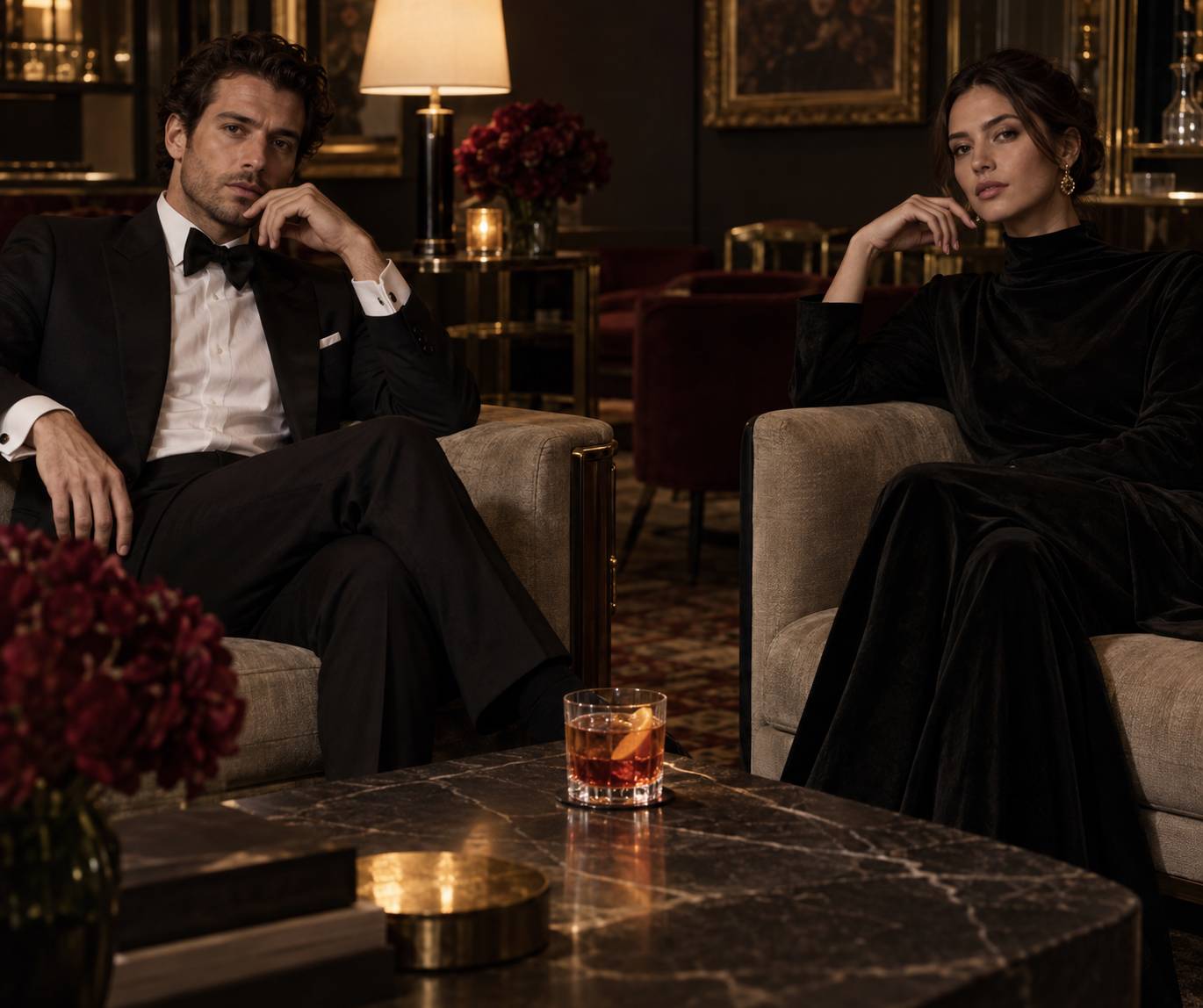
The smoking jacket was designed in the 1850s, and a London magazine of the period described it as a garment “of velvet, cashmere, plush, merino or printed flannel, lined with bright colours,” worn after dinner. The tea gown entered the Oxford English Dictionary in 1878 as a dress for informal entertaining at home. It was worn without a corset and, by 1900, worn in the evening in front of guests. Black tie belongs to the same lineage. The dinner jacket arrived in the 1880s as a dress version of the sack suit, and across the 1890s it became acceptable for evenings at home or at a club.
So the most formal thing in most wardrobes started life as a garment for staying in, which is a decent argument for the velvet jacket and against the idea that dressing up requires leaving. If you’d rather build the whole night around one considered piece, that’s the older instinct too. The smoking jacket and the tea gown were both worn for people who were in the room with you. That is the part a screen takes away, and it takes it away asymmetrically.
One of the largest UK casinos is the Hippodrome, where dealers are expected to dress smartly, and its casino portal features live blackjack online in a similar fashion, with croupiers adorned in smart uniforms to portray a more luxury appeal to its’ players. It is the exact inversion of 1638, when the masks were compulsory for the players and nobody cared what the house had on.
The Light Is the Whole Trick
A candle flame burns at roughly 1,850 kelvin, the same color temperature as a sunset. The soft white bulbs most of us already own, incandescent or LED, sit around 2,700K. Daylight-balanced lamps land near 6,500K, which is the color of an overcast sky and has no business in a room after dark. Kelvin is the number on the front of the box. The two that matter more are usually further back, or missing.
CRI, the color rendering index, averages a lamp’s performance across eight test colors. Department of Energy guidance calls the 70s acceptable for interiors, the 80s good and the 90s excellent.
R9 scores saturated red on its own, and it’s the figure that decides how skin reads, since “the rendition of saturated red is particularly important for the appearance of skin tones.” R9 runs on the same zero-to-100 scale as CRI, and anything above zero counts as acceptable, which tells you where the bar has been set.
Brightness is a separate axis again, and it points the same way. An international expert panel writing in PLOS Biology in 2022 recommended a maximum of 10 melanopic lux in the three hours before bed, which is a good deal darker than most people running a living room at nine at night.
Two Drinks, Measured
The International Bartenders Association’s Negroni is exactly equal to thirds: 30 ml gin, 30 ml Campari, 30 ml sweet red vermouth, poured straight into a chilled old fashioned glass over ice, stirred gently, half an orange slice. Its Dry Martini is 60 ml gin to 10 ml dry vermouth, stirred in a mixing glass with ice, strained into a chilled glass, with the oil from a lemon peel squeezed over the surface.
Check the Negroni story before you tell it at your own table, because it does not hold up. The Florence account, in which a count asked a bartender to strengthen his Americano with gin in 1919, is tradition rather than documentation, and the first recipe printed under the name appears in Spain in 1949. The Martini has no origin story to demolish; nobody knows who made the first one. What is on the record is that it changed. A sweet version was in print by 1888 and a recognizably dry one by 1904, so it took sixteen years to dry out.
The Room, Not the Screen
Edward Hall’s proxemics puts the far phase of personal distance at roughly 2.5 to 4 feet and the close phase of social distance at 4 to 7 feet. A dinner table seats people in the first. Two sofas across a coffee table usually land in the second, which is roughly the distance you hold with an acquaintance.
Tempo does something similar to a room. A 2024 field experiment tracked 282 tables at a restaurant in Tel Aviv and found that with slow music, at or below 72 beats per minute, diners stayed around eighty minutes. With fast music, at 94 beats or above, they stayed under sixty minutes. That is roughly twenty minutes of an evening, bought with a slider. The chairs move. The lamps are already in the house.