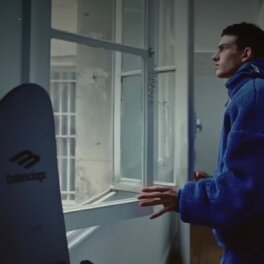
Inspired by his own experiences in Berlin’s nightlife scene, a difficult breakup, and the question of what it really means to grow up, Jordan Firstman transforms his feature directorial debut into a deeply personal story about queer identity, unexpected fatherhood, and finding purpose.
What happens when the person who has spent years avoiding responsibility suddenly has someone depending on him? That’s the question at the heart of Club Kid, the new film from actor, comedian, and filmmaker Jordan Firstman. But behind its colorful nightlife, chaotic parties, and unexpected family drama is a story that hits much closer to home than audiences might expect.
Firstman writes, directs, and stars as Peter, a New York City nightclub promoter whose life revolves around parties, drugs, and the freedom of the queer underground scene. His routine takes an unexpected turn when a 10-year-old boy named Arlo (Reggie Absolom) appears at his door. After Arlo’s mother dies, Peter discovers that he is the boy’s biological father. Suddenly, the man who has built his life around doing whatever he wants has to figure out how to take care of someone else.
It’s an unusual coming-of-age story because Peter isn’t a teenager. He’s a man in his thirties who is only beginning to understand what growing up actually means.

Courtesy: A24
The Real Life Behind the Party
To understand Club Kid, you have to understand where Firstman was emotionally when he began writing it.
Before becoming known for his viral Instagram impressions and roles in projects like Rotting in the Sun and HBO’s I Love LA, Firstman spent years immersed in nightlife. In interviews, he has spoken openly about his time in Berlin, where partying could take over entire weekends. He described a lifestyle of going out from Thursday through Monday, followed by days spent recovering from the emotional and physical lows.
At around 32, he began questioning whether he was partying too much and what his future would look like if nothing changed. That became the starting point for Peter.
Firstman has described the film as a delayed coming-of-age story about a gay man in his thirties. Rather than creating a character who suddenly becomes responsible because he has everything figured out, he wanted to explore someone who is still learning how to take care of himself.
And that’s what makes the story interesting. Peter doesn’t simply leave nightlife behind. He has to confront the person he has become, the relationships he has neglected, and the possibility that there might be something more meaningful waiting for him outside the club.

When Real Heartbreak Becomes Art
There is another personal layer to the film: heartbreak.
While developing the screenplay, Firstman was going through the end of a relationship with someone he has described as the love of his life. The breakup left him with feelings of love, abandonment, and disappointment that he eventually brought into the story.
In an interview with Vanity Fair, he explained how emotionally difficult it was to film certain scenes. For one particularly vulnerable moment, he looked through old photographs of his ex and wrote a final message before stepping in front of the camera. The result was an emotional performance that he described as one of the hardest moments of his career.
This is where Club Kid moves beyond a comedy about an irresponsible party promoter. Beneath Peter’s humor and chaotic lifestyle is someone who struggles with self-esteem, loneliness, and the difficulty of letting other people see who he really is.
Firstman has often been associated with an outspoken, provocative comedic persona. With this film, he wanted audiences to see a more vulnerable side of himself. In a way, Peter becomes a reflection of the parts of Firstman that are less visible behind the jokes.
A Love Letter to Queer Nightlife
The film also pays attention to the world that shaped its protagonist. Firstman wanted to capture the energy of New York’s underground queer party scene, not just as a backdrop for the story, but as a community with its own language, characters, and sense of belonging.
Instead of relying entirely on traditional background actors, he brought real people from the nightlife scene into the film. He also worked with actual club spaces and locations in New York, including areas of Chinatown and the Lower East Side, to create a more authentic atmosphere.
For Firstman, showing nightlife honestly meant showing both sides of it: the freedom, connection, creativity, and joy, but also the excess and the consequences that can come with that lifestyle.
The result is a film that celebrates queer culture without pretending that every part of it is perfect. It recognizes the beauty of finding a community while asking what happens when the lifestyle that once made you feel free starts keeping you from moving forward.

From Viral Comedy to Cannes
For anyone who discovered Firstman through his internet comedy, Club Kid represents a different chapter in his career.
He first gained widespread attention during the pandemic through his exaggerated impressions and comedic videos. Since then, he has expanded into television and film, but Club Kid marks his feature directorial debut.
The project premiered in the Un Certain Regard section at the 2026 Cannes Film Festival, where it received a seven-minute standing ovation. A24 ultimately acquired the film after a competitive bidding process, bringing Firstman’s deeply personal story to a wider audience.
And perhaps that’s the most interesting part of Club Kid: it takes a very specific world, one that many viewers may never experience firsthand, and uses it to tell a remarkably universal story.
Because growing up doesn’t necessarily happen when you turn 18, 25, or even 30. Sometimes it happens when life puts something in front of you that makes you reconsider everything.
For Peter, that something is Arlo. For Firstman, it was a combination of personal reflection, heartbreak, and the realization that he had more to say than the internet’s funniest impressions could ever capture.
Club Kid arrives in U.S. theaters on November 6, 2026.