By Please use any from yours
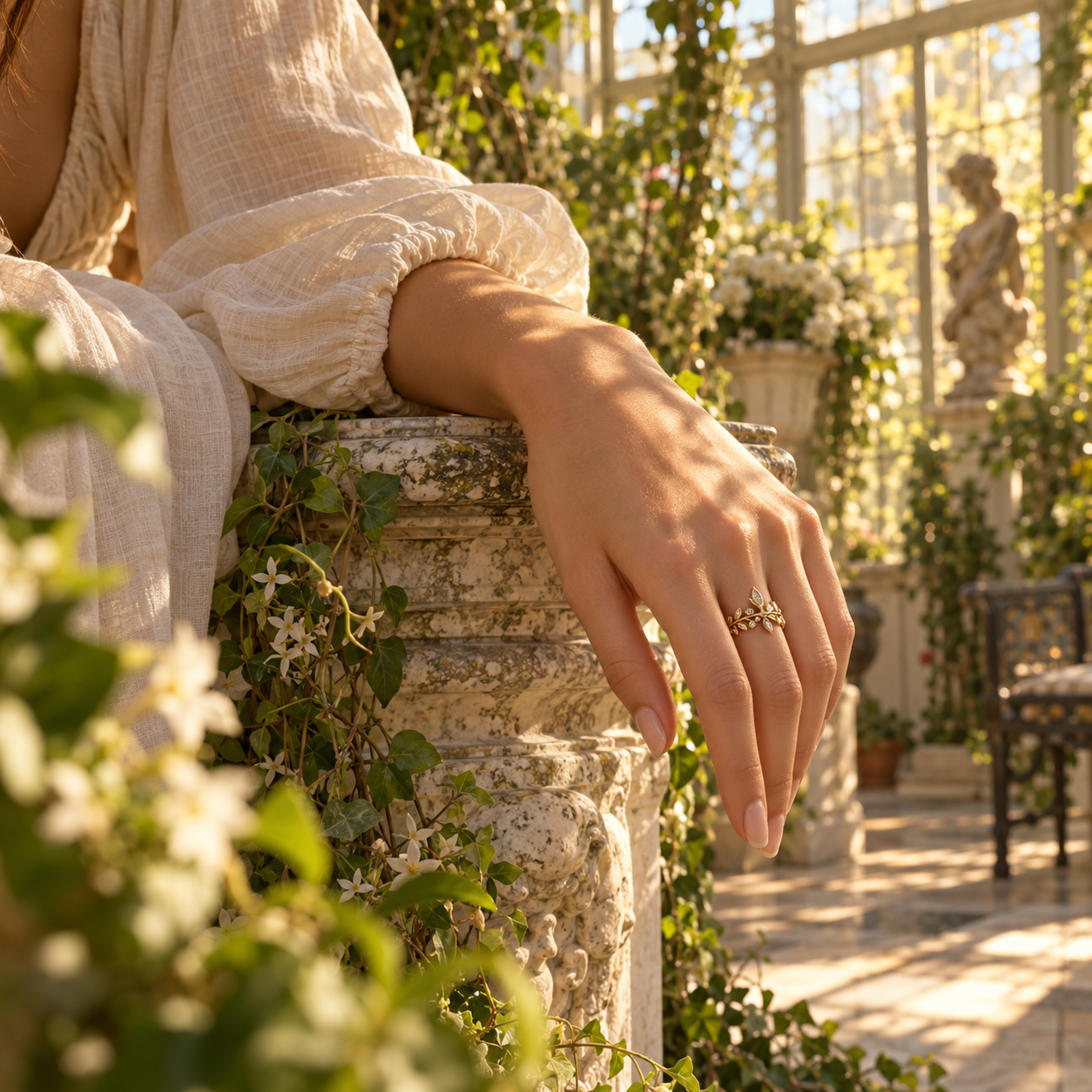
An engagement ring isn’t just a proposal snapshot. It’s going to live on your hand through morning coffee, Zoom calls, sweater weather, and countless outfit swaps. That means the design needs to feel like you, not just look stunning under jewelry-store lights.
The Ring as an Everyday Style Piece
Celebrity engagement rings can be a fun way to notice specific details. You might spot a horizontal setting, a vintage-cut center, or a marquise silhouette that catches your eye. These aren’t templates to copy. They’re starting points for noticing what you’re drawn to.
BELLO recently explored how floral versus classic engagement ring styles reflect personal meaning and relationship identity, and that same idea applies here. Your ring can be an extension of your everyday style, not a departure from it.
Start with the Jewelry You Already Wear
Before you dive into carat weights and clarity grades, take a beat to study your current collection. Where do your instincts land? Are you all about clean, uninterrupted metal, or do you love delicate filigree and texture? Does yellow or rose gold feel warm and familiar, while white gold or platinum feel dressy and crisp?
You don’t need to match everything; mixing metals and textures can be intentional and cool. But thinking through a few style preferences early on keeps you from getting lost in endless scrolling.
Pick two or three priorities: maybe a low-profile setting, an organic motif, or a center stone with a distinct shape. These aren’t hard rules about personality or skin tone. They’re just a way to filter the noise.
Then imagine how this new ring will sit next to the pieces you already reach for each day. Will it stack effortlessly with a slim gold band, or do you need a little negative space to let it breathe?
BELLO’s guide to stackable ring styling walks through metal mixing, texture layering, and personal expression, helpful stuff if you want your engagement ring to feel like a natural addition to your jewelry rotation.
The style of ring you choose shouldn’t be about what’s trendy—it should reflect something real about your identity.
Consider a Horizontal Setting for a Geometric Look
If traditional north-south settings feel predictable, an east-west orientation can bring a crisp, architectural energy to your hand. An east-west setting lays the diamond horizontally, perpendicular to the finger, rather than pointing upward in the classic way.
According to Vogue, this style was big in the Art Deco era and “very hard to find in the modern market until the past five years or so,” as jewelry director Daisy Shaw-Ellis puts it. Elongated shapes work best for this look. A marquise, oval, elongated cushion, or emerald cut really sells the horizontal line.
At the 2025 Golden Globes, Zendaya wore a bezel-set east-west diamond engagement ring designed by Jessica McCormack, which Vogue reported as a breaking away from the usual trend of setting the stone vertically. The bezel frame and low profile make the ring feel substantial and understated at the same time.
If that geometric personality clicks with you, Leonids Jewelry‘s Ivy ring takes a similar path. It features an emerald-cut lab-grown diamond in a bezel setting with clean Art Deco lines, no extra fuss. The Ivy starts at $1,400 for a 1-carat center in 14K yellow gold, with a face-up measurement of 4.75 mm × 6.75 mm.
You can choose from 14K yellow, white, rose gold, or platinum, and every ring arrives with IGI certification. The horizontal silhouette and bezel profile make it a modern alternative to the usual solitaire.
Look at Vintage Detail Beyond the Center Stone
Taylor Swift’s engagement ring, designed by Travis Kelce with Kindred Lubeck of Artifex Fine Jewelry, puts vintage cut choices front and center. The couple announced their engagement on Instagram in August 2025.
ABC News reported that the center stone is an old-mine brilliant cut, a squarish diamond with a smaller table, larger culet, and higher crown than most modern cuts. The GIA notes that this style was common from the early 1700s to the late 1800s, and it has a distinctive, warm look.
That kind of vintage character doesn’t require an old-mine cut, though. You can find the same soulful feel in the metalwork itself. Milgrain beading, filigree patterns, and vine-like motifs bring an heirloom quality to a setting, even when the center stone is a brilliant modern oval. The magic is in the small details that catch light and shadow.
Leonids Jewelry’s Adeline ring leans into that old-world charm with an oval lab-grown center, intricate milgrain detailing, and marquise-shaped vine motifs set with eight round diamonds (0.08 CTW).
It’s not an old-mine cut, and it’s not trying to recreate Swift’s ring. The vintage inspiration comes from the craftsmanship: the delicate texture, the botanical flow, the way the band feels like a miniature work of art.
The Adeline starts at $1,240 for a 1-carat center in 10K yellow gold and is available with center stones up to 3 carats, IGI certified.
Explore Marquise Shapes and Botanical Detail
A marquise center is a shape choice, not automatically a floral statement, but it pairs beautifully with nature-inspired settings.
Selena Gomez’s engagement ring, a marquise-shaped diamond on a pavé band, was announced in December 2024 (Vogue). While that news is two years old now, the marquise silhouette remains a design detail worth exploring if you’re drawn to elongated, eye-catching shapes.
Where the botanical personality comes in is the setting. Two rings with the same marquise center can read completely differently. It all depends on what’s happening around the stone.
Leonids Jewelry’s Kathleen ring frames a marquise-cut lab-grown center with flowing vine details and two delicate marquise side stones (0.22 CTW). It’s organic, romantic, and full of motion. The Sable ring, on the other hand, groups six marquise side stones (0.66 CTW) into distinct petal accents that sit like a bloom beneath the center.
Both use a marquise center. Both feel botanical. But one whispers “vine,” while the other says “petal cluster.”
Kathleen starts at $1,580 for a 1-carat center in 10K yellow gold, up to 3 carats. Sable begins at $1,650 for a 1-carat center, with stones available up to 4 carats. Both are IGI certified, and both show how the same center shape can express two very different sides of your personality.
Turn the Inspiration into a Practical Shortlist
All the designs we’ve walked through use lab-grown diamonds, so let’s clear up what that actually means. Lab-grown diamonds are optically, chemically, and physically identical to natural diamonds. IGI confirms they share the same hardness, refractive index, and dispersion. The GIA evaluates them on the same universally recognized clarity scale, noting that lab-grown stones have their own distinct inclusion characteristics that trained gemologists can identify.
In other words, you’re not dealing with a simulant. You’re dealing with the same material, created in a different setting.
When you start comparing rings online, a simple checklist keeps you grounded.
Look at the exact millimeter dimensions of the center stone, not just the carat weight. A 1-carat emerald cut can vary in face-up size depending on proportions. Check the setting’s height from the profile view. A lower profile often works better if you use your hands a lot or plan to wear gloves.
Confirm which metals are available and think about how a wedding band will sit alongside the ring. A curved or contoured band might be necessary with certain basket settings.
Brands like Leonids Jewelry maintain a consistent quality range: D–E color grades and VS–VVS clarity grades across their lab-grown diamonds. For center stones of 0.5 carats and above, the company provides IGI certification; for finished jewelry with a center stone smaller than 0.5 carats, it provides an AGL finished jewelry certification. That gives you objective third-party documentation of what you’re buying.
Through its factory-direct model, Leonids removes traditional wholesale and retail markup layers, which means more of your budget lands in the diamond, metal, and finish.
You can also customize the cut, carat weight, metal type, ring size, engraving, and production timeline on each product page, or submit a fully custom design via their dedicated custom page. Just be mindful that customization can affect return eligibility.
So, before you commit, run through this mental list: confirm the millimeter dimensions, select your metal, verify setting height, check that certification is included, and read the fine print on customized orders. A little diligence upfront saves a lot of second-guessing later.
Caveats and Counterpoints
It’s worth keeping a few things in perspective.
The celebrity rings mentioned here are style illustrations, not current endorsements. Selena Gomez’s ring is a 2024 moment, and the design detail still works, but treat it as historical inspiration, not a hot trend.
Lab-grown diamonds match natural diamonds chemically, but market pricing and resale expectations follow different norms. This article doesn’t make value-retention or environmental claims, because those conversations require much more context.
At the time of writing, independent third-party reviews of Leonids Jewelry were scarce. No dedicated Reddit threads or YouTube reviews surfaced in searches, so a buyer will lean heavily on the brand’s own product-page details and official policies.
That said, a rating of 4.9, significant number of positive reviews, and video testimonials on their site hint at the positive experience buyers have had so far in ordering from the brand.
Absence of third-party reviews isn’t a clear-cut red flag, but it does mean you should verify availability, metal options, and service terms directly on the website before you order.
Check the Details Before Ordering Online
An accurate ring size is the simplest thing that can save you a headache later. Leonids Jewelry offers ring sizing, and each ring includes one complimentary resizing of ±0.5 US size during the warranty period. All orders within the US include free shipping.
Most pieces are made to order, so expect roughly 2 weeks (15 business days) for production, with silver and platinum adding 3 additional business days. Rush production is available on request if you’re working against a timeline, and cuts about 4–6 days from production and shipping time.
Returns are straightforward if the ring is unworn and in original packaging: free returns within 30 days of delivery for all US orders. Custom pieces, engravings, and made-to-order modifications are final sale, so factor that in when you’re personalizing.
The one-year craftsmanship warranty covers loose prongs, the first occurrence of a missing accent stone, plating issues, and that one resizing for up to ±0.5 US ring size.
Behind the scenes, every Leonids Jewelry piece goes through a five-step pre-shipment inspection: metal purity test, structural integrity check, gemstone certification match, finish and polish verification, and a wear-and-tear simulation. It’s a level of diligence that signals the brand wants you to open the box confidently.
Conclusion
In the end, the ring that fits your personal style is the one you’ll want to put on tomorrow, and the day after, without overthinking it. By zeroing in on details like a horizontal silhouette, vintage milgrain, or a botanical vine that speaks your language, you’ll end up with a ring that feels less like a purchase and more like a piece of your daily life.


