


Fearless, Funny, and Unapologetic: Maitlyn Fletcher Reinvents Queer Storytelling
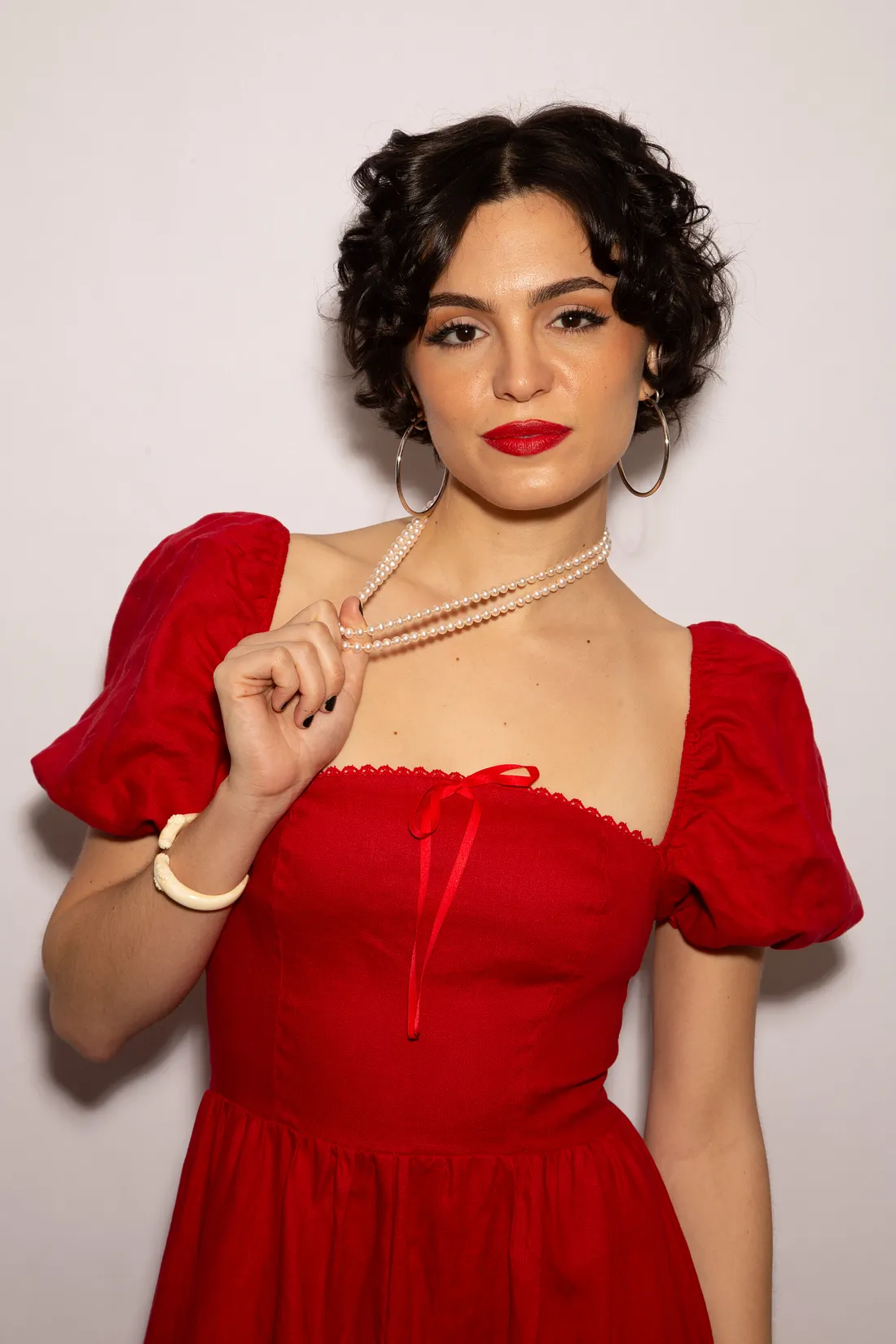
Meet Maitlyn Fletcher, Hollywood’s next queer trailblazer redefining live-action storytelling with audacity, humor, and heart. A writer, director, and producer with a flair for the absurd, Fletcher has already made waves with her outrageous sketch GOLDEN DCK*, a sharp, comedic critique of femme lesbian erasure, and is set to push boundaries even further with her upcoming film MOUNTING RUSHMORE—a whimsical coming-of-age tale that fuses handmade miniatures, 2D animation, and live action into a dazzling, offbeat spectacle. Drawing inspiration from cult classics, iconic auteurs, and the irreverent spirit of early-2000s cinema, Fletcher infuses her work with bold queer narratives, camp energy, and fearless originality. In this conversation, she opens up about her creative journey, her mission to reclaim joy in queer storytelling, and how she’s reinventing the rules of representation one wildly inventive project at a time.
Bello: You’ve been described as a fearless creative force who blends cartoonish energy with bold queer narratives. Can you walk us through how your personal journey helped shape this vibrant, irreverent approach to storytelling?
I grew up watching an excess of cartoons (arguably too many). I watched some classic kid content, like Looney Toons and Adventure Time, but at an incredibly young age I was also watching The Simpsons with my parents, the only adult cartoon they deemed appropriate for a seven-year-old. Against my parents’ wishes and staying up way past my bedtime, I sneakily managed to watch Adult Swim (Family Guy, King of the Hill, etc.). Thus, my preschool teachers would often report that I had a disturbingly mature sense of irony. My obsession with cartoons wasn’t the only reason for this though: I was always a freakish kid. I’d make up stories about other kids’ dolls being made of dead people’s hair and I believed I had a secret girlfriend who lived in a toilet bowl. These cartoons resonated with me because they felt as specific and saturated as I was; they felt like the world I lived in. Being queer also lends itself to a cartoonish view of the world! The queer community is so vibrant and filled with exaggerated performance. Queerness leads to an alienation from the norm; therefore, it also often leads to a fantastical, colorful, hyper-specific view of reality. Being gay and a freak has allowed me to understand that queer experiences can be accurately told through a cartoonish energy, as straying from the norm can often make you feel like a cartoon.
Bello: GOLDEN D*** is both hilarious and sharply poignant, it’s not every day you see a penis puppet used to tackle femme lesbian erasure. How did this concept come to life, and what conversations were you hoping it would spark?*
Why, thank you! GOLDEN D*** is a liberal arts tale about an indie boy who attempts to woo a hot lesbian freshman, and is somehow surprised to find all his normally successful moves fall flat (including whipping out his eleven-inch puppet dick). The sketch aims to explore Golden Dick Syndrome, which refers to the inflated ego many men come to have on predominantly female college campuses. Alina Foley (my co-creator, college roommate, and best friend) and I based this sketch on our experiences with many men on Sarah Lawrence Campus as two femme lesbians. Through this sketch, we were hoping to inspire a laugh or two, but also a discussion of the dismissal femme lesbian visibility and alarming male ego inflation at liberal arts colleges. The penis puppet was essential to discussing these issues while keeping the sketch funny. GOLDEN D*** includes overt sexual harassment that may be hard for many people to watch if a real-looking, prosthetic penis was used. Alina and I made the creative decision to use a puppet in place of a realistic prosthetic for comedic effect, but also to make the story more digestible while keeping the moment as disturbing as possible. Plus, making the penis puppet absurdly big with Muppet-like eyes conveys exactly how exceptional the indie boy believes his penis, and therefore, himself to be.
Bello: MOUNTING RUSHMORE sounds like a visual playground. What drew you to mixing handmade miniatures, 2D animation, and live action, and how do those mediums help you express the queerness and awkwardness of coming-of-age?
Here’s the tale of MOUNTING RUSHMORE: on a trip to Mount Rushmore, a teenage girl’s plan to lose her virginity is complicated by her lust for her boyfriend’s sister and her boyfriend’s recently realized George Washington fetish. Our protagonist and her boyfriend are queer characters who have their respectively outlandish coming out stories in this film. Realizing you’re gay is terrifying and often heart wrenching… but also really funny. When one experiences sexual awakening that doesn’t match the widely-accepted “man meets woman, falls in love, and has missionary sex,” they are bound for a slew of ridiculous experiences. Although starting to navigate sexual activity is awkward for most, for young queer people, their first encounter is often an incredible failure, especially because these sexual encounters are often with people they are not truly attracted to. In MOUNTING RUSHMORE, I want to convey the common cartoonishly bad and whimsically odd qualities of primary, queer sexual experiences. Through 2D animation (created by the talented Charlotte Brann-Singer) and campy DIY miniatures accenting the live-action, I aim to portray the other-worldly and silly quality to coming out.
Bello: You’ve cited inspirations like Tim Burton, John Waters, and early-2000s cinema. How do those influences show up in your work and how do you balance nostalgia with innovation?
While I’m certainly inspired by the incredibly talented Tim Burton and John Waters, it is not the content of their work which inspires me but rather their stylized filmmaking. Tim Burton and John Waters both create their own, unique, exaggerated personal worlds. Inspired by the specificity of their worlds and characters, I aim to create my own projects with a personally specific lens. In terms of 2000s cinema, I absolutely love the goofiness and freeness of that era of comedy. I aim to revive that type of “fun” in my work, but often apply it to narratives that were poorly represented in 2000s comedy, such as queer people, the elderly, etc.
Bello: There’s often a default melancholy tone in queer storytelling. You actively reject that. Why is joy, absurdity, and camp so important in your work and what does reclaiming that space mean to you personally and artistically?
As I aim to explore in my most recent project, MOUNTING RUSHMORE, being queer can pose personal and external challenges and be really difficult to navigate, but it can also be absurd, fun, and beautiful! Even queer hardships often have a kind of whimsy to them. I want to explore queer joy and sadness through an undeniably queer lens. Queer people, historically, have championed vivacity and fun in the face of hardship, I want my work to do the same. Though it may sound corny to some, I start every day with “gratitude affirmations” and try to champion joy in my everyday life, even if I’m facing difficulties. Having been bullied as a kid, I had to learn fast to find little joys and choose laughter whenever I could. There was and is so much to value about being a freak and it feels like an ode to little Maitlyn to champion freakishness as something fun and wonderful.
Bello: How do you navigate the challenge of creating something that’s unapologetically queer and wildly imaginative, while still keeping it emotionally grounded and relatable?
While not everyone’s queer, most people can relate to feeling alienated or “other.” Feeling alienated is often a kind of absurd experience that I aim to encompass in my wildly imaginative world. Therefore, I think my work is often emotionally grounded and relatable because of its queer and imaginative qualities, not in spite of them.
Bello: From Bojack Horseman to Adventure Time, your references are known for blending humor with heartbreak. What role does emotional complexity play in your storytelling?
In future projects, especially more long-form ones such as a TV series, I aim to explore more dark and emotionally complex themes in my plot and storytelling. At this point, however, emotional complexity comes through my characters rather than my plot. The situations and scenes I write are often kooky and fun but the characters I write are often grappling with an emotionally difficult inner conflict/want. Their wants or inner-conflicts can also have a comedic edge, but they are serious to the character, which allows for emotional complexity in my work.
Bello: You grew up as “the quiet one”, now you’re producing work that’s loud, audacious, and deeply expressive. What was that transformation like, and how does your past inform your present creative voice?
The transformation was so freeing! I grew up so quiet, largely because I was afraid to fail. I was afraid that if I’d speak I’d say something strange and people wouldn’t like it and therefore, I would “fail” at the social interaction. It wasn’t until college where I let go of my fear of failure that I allowed myself to be as expressive out loud as I was in my head. I think my quiet past inspires my work to be even louder and bolder than it would have been if I were so unapologetically myself for my whole life. I see being free and audacious as such a privilege and joy, so I aim to encompass that in all my work.
Bello: In your eyes, what’s missing from the current landscape of queer media, and how are you working to fill those gaps through your projects?
To me, the only demographics that are largely represented in queer media are young fully-gay men and young bisexual women. We are largely missing so many other categories (such as elderly queer people, lesbians, bisexual men, transgender people, etc.). I aim to fill these gaps in some way in most, if not all of my projects. MOUNTING RUSHMORE is an unconventional coming-of-age tale about a bisexual boy and lesbian girl in a lavender high school relationship. I’m currently writing a pilot for an animated television series (It’s Old School) that follows a group of queer elderly women at a Palm Springs retirement community.
Bello: If you could give young queer creatives one piece of advice about making art that breaks the rules, what would it be?
Don’t be afraid to “fail” and stay true to yourself or your work will suffer! When I worried about others judging me or creating something perfect, my writing suffered from inhibition. When I finally embraced myself and became less afraid of “failing,” every aspect of my writing improved. I learned creativity requires vulnerability both on and off the page.