
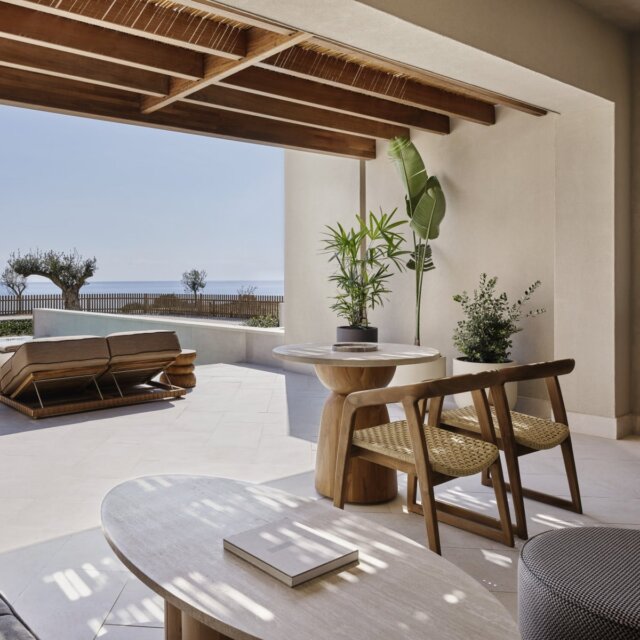
Amoh, a Luxury Collection resort on a private peninsula, turns an ancient limestone quarry into a stone-and-timber study in Greek craft, with interiors by London's Studio Lost.
The limestone for the Acropolis of Lindos came from a coastal quarry on Rhodes. That same patch of land now holds a hotel with 197 rooms and suites. Amoh resort Rhodes, a Luxury Collection property on a private peninsula, has London-based Studio Lost behind its interiors. The studio decided early not to hide what the site used to be. The full story is at Design Milk.
Stone first, always
The architecture stays low. Flat roofs, clean lines and recessed openings keep the silhouette close to the ground, so the hotel sits comfortably in its surroundings. The rooms are grouped in village-like clusters, which gives a big resort a more intimate scale. The overall look is restrained Mediterranean, channeling the rugged coastal landscape of the island.
The materials do the storytelling. Monumental carvings, monolithic columns, polished vanities and marble furniture all nod to the quarrying that once happened here. Large-format limestone tiles from Atlas Concorde add to the stone-led palette.
Studio Lost founder Constantina Tsoutsikou explains the choice. Stone evokes a “sense of permanence and timelessness, telling the story of Ancient Greek heritage and craftsmanship like no other material.”
Pebbles, laid by hand
The most charming detail is underfoot. Rhodian pebble mosaics are a technique native to the island and traditionally belong to local courtyards. Here, one of the island’s remaining master craftsmen laid the flooring by hand. Each pebble was picked for its shape and color, then set into an intricate pattern. That is slow work, and it shows.
Timber supplies the counterweight. Dark-stained wood brings warmth next to the heavy stone, and French house Casamance supplied wallcoverings. A continuous herringbone pattern runs from inside to the outdoor spaces, so the line between them blurs. Tsoutsikou calls the bespoke joinery an integral part of the resort’s architectural language, not only a functional one. The design team used the wood to add warmth and contrast against the more substantial stone elements. “It connects craftsmanship to a sense of place,” she says. She points to the “intricately detailed VIP pergolas to sculptural screens and bespoke latticework” and says the joinery “establishes a new benchmark for contemporary Greek hospitality design.”
Aegean blues, quarry textures
The color story comes from the sea. Dark blues and emerald greens run through the interiors. Weathered earth tones and bronze accents keep the richer shades in check. Honeyed stone and oxidized metal finishes echo the worn surfaces of the quarry next door.
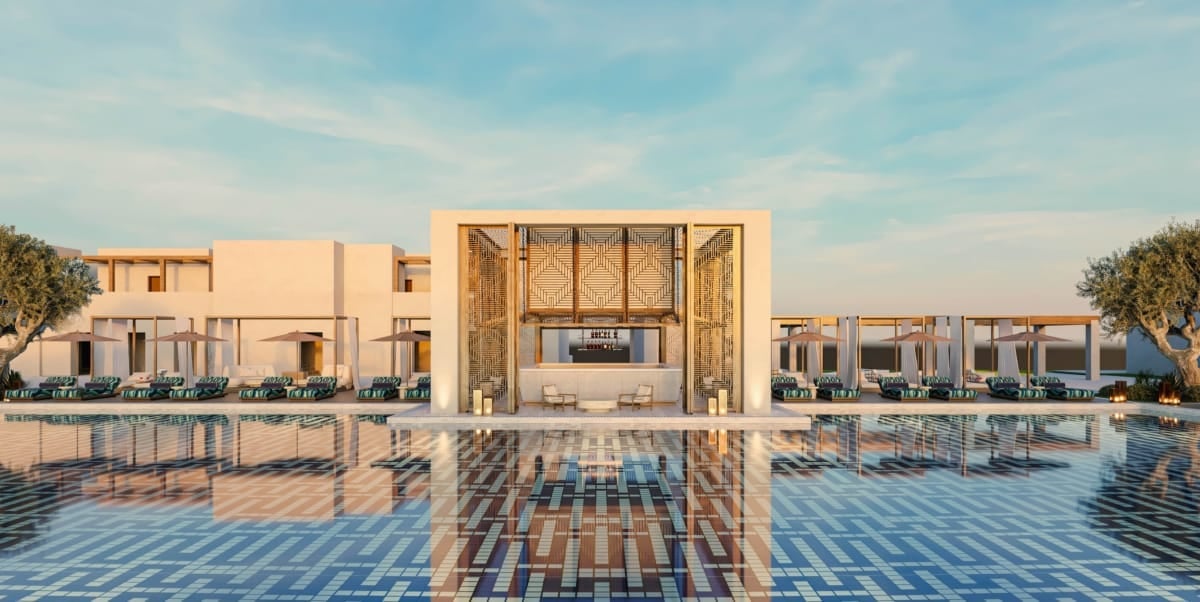
The spa goes quieter, with soft pastels and warm oak. It has seven treatment rooms, a wet lounge, an ice fountain, a steam room and a dark timber sauna, plus delicate greens that tie back to the wider palette. The pool is the social center, anchored by a light-filled pavilion. The central bar has timber lattice screens that reinterpret Greek geometric patterns. Cabanas and big water views frame it.
Four restaurants, four takes
Each of the four restaurants reads the design language in its own way. The open-air restaurant has canvas canopies and colorful terrazzo tables, and it recalls early 20th-century archaeological expeditions. At Glaze, the ceramic-firing process inspired an open kitchen that puts the cooking on show. Lithos has a soaring atrium, stone-clad walls and custom suspended timber screens, which add texture and a sense of intimacy.
Oversized artwork and handcrafted objects appear throughout. They add a personal note to all that monumental stone.
Tsoutsikou sums up the approach: “Rather than relying on familiar Mediterranean clichés, we celebrated the richness of Greek craftsmanship.” The resort draws on the island’s history without trying to recreate it. Old materials and techniques get a contemporary setting, and the quarry that built Lindos is still part of the picture.
Via Design Milk


