
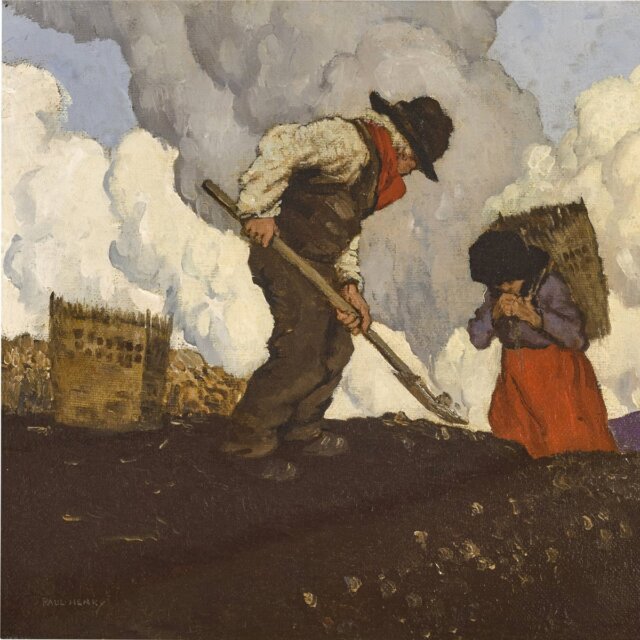
Estimated at up to £350,000, "The Potato Harvest" hammered at £883,200 in London. The Paul Henry auction record says plenty about who is buying Irish art.
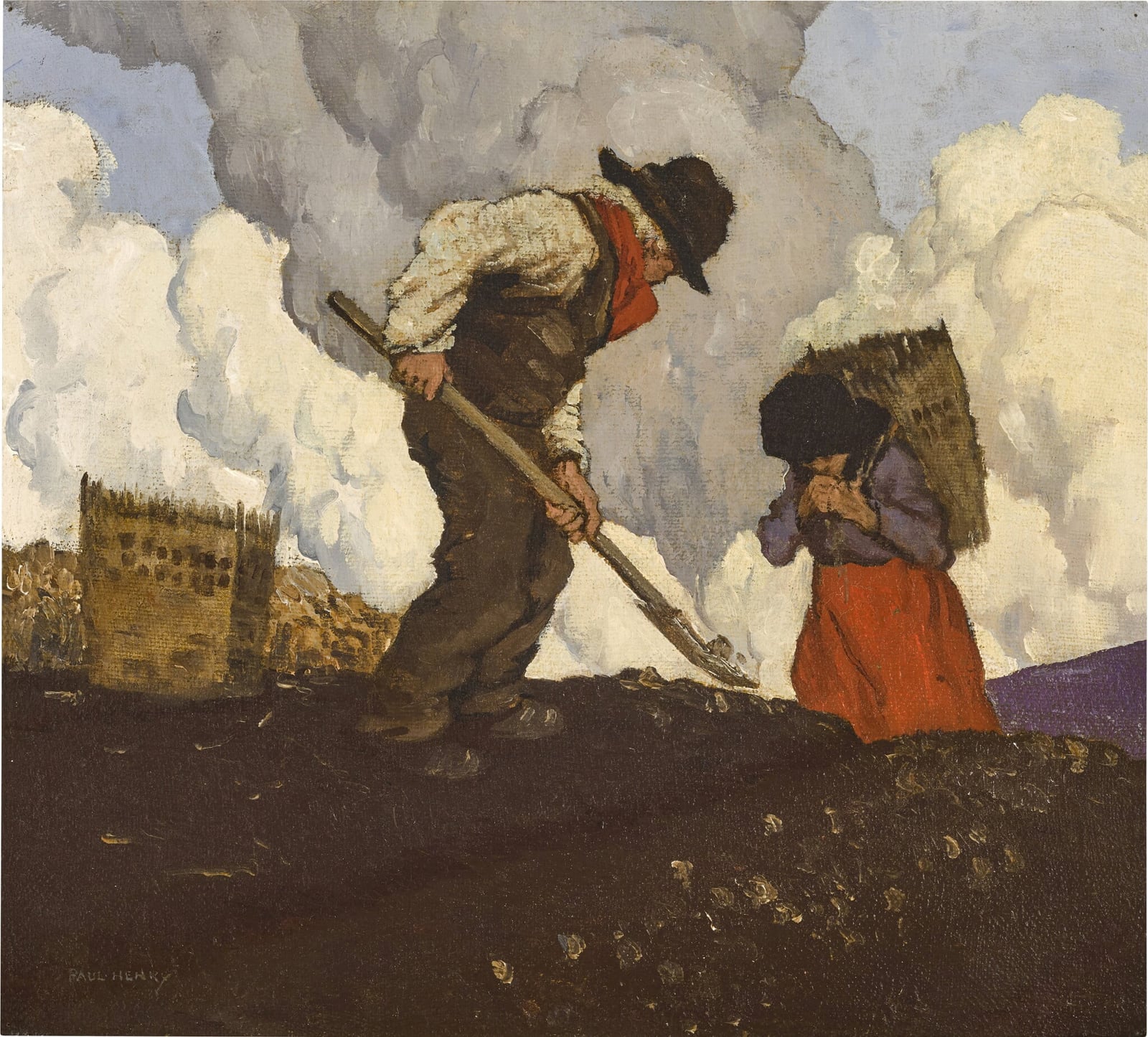
Someone just paid £883,200 for a painting of people digging potatoes, and the room at Sotheby’s London was not especially surprised. Paul Henry’s The Potato Harvest sold on 14 October for about €1.05m, including the buyer’s premium. That is a Paul Henry auction record, and roughly three times the middle of its £250,000 to £350,000 estimate.
The oil on canvas shows Mayo people at work in the field. It topped the Sotheby’s sale of modern British and Irish art, and it went to an international collector with Irish roots. According to André Zlattinger, Sotheby’s head of UK and modern art in Europe, that buyer already owns Paul Henry paintings and other Irish works. So this was a collector adding to a collection, not trying a new genre.
Why a field of potatoes beat its estimate
Start with scarcity. Henry is best known for the landscapes and seascapes he painted on Achill Island, where he lived from 1910 to 1919. Sotheby’s calls him a “visual poet” of the west of Ireland. Big figurative canvases are the harder find. Zlattinger says beautiful figurative Henrys such as The Potato Harvest and Turf Gatherers rarely come to auction. “There is a number of them in public collections,” he says, “but there has only been a handful of them in auctions over the last 20 years.”
A handful in 20 years is not much supply. When one turns up, anyone who has been waiting has to decide quickly how much patience is worth.
The old record was £622,500, paid at Christie’s in July 2021 for Mountains and Lake, Connemara. The new one clears it by a comfortable margin.
Who is buying
Zlattinger describes a broad field. Works by Roderic O’Conor, William Orpen and Paul Henry, he says, are sought after by Irish collectors, expat Irish collectors, and American, English and international buyers. He puts Irish art on a par with Scottish and modern British art for price and demand.
Arabella Bishop, a Dublin art adviser, reads the result as a sign of reach. It “demonstrates the appetite that exists for Irish art internationally,” she says, “and highlights the value of exposing our artists to a wider pool of collectors”. In her view, that exposure strengthens Irish art’s international reputation and shows there is wider market appeal.
The rest of the Sotheby’s sale backs her up:
William Orpen’s Little Spanish Dancer, offered at auction for the first time, made £358,400, nearly double its low estimate of £180,000. Gerard Dillon’s Boy Catching Crabs in Connemara sold to an international collector for £281,600, more than double its top estimate of £120,000. Roderic O’Conor’s Red Rocks and Foam made £243,200 against an estimate of £150,000 to £200,000.
Not everything flew
The picture was not uniformly rosy. Two Jack Butler Yeats paintings and another Paul Henry failed to sell at Sotheby’s. Even famous names, it seems, are sensitive to the asking price. A good signature does not rescue a number that is too ambitious.
Christie’s held its own British and Irish sale in London the following day, and the pattern held there. Henry’s The Fairy Thorn, estimated at £100,000 to £150,000, sold for £256,000. It had stayed in one collection since 1929. It was first shown in New York in Contemporary Irish Art: First American Exhibition, and bought by John Jakob Raskob, the businessman who built the Empire State Building.
Dillon’s The Cottage Window was estimated at £70,000 to £100,000 and sold for £200,000. It had belonged since 1950, the year it was painted, to the late Zoltan Lewinter-Frankl, a Hungarian-born, Belfast-based patron who collected Dillon, Colin Middleton, Daniel O’Neill, Basil Blackshaw and others. Yeats’s The Crown of Ocean, painted in 1945, made £128,000 against £100,000 to £150,000, which put it within its range rather than above it.
Provenance, then, matters. A picture with a long, documented life in one place tends to draw bidders, and the Raskob and Lewinter-Frankl stories were part of what made those lots interesting.
For smaller budgets
Six figures is not the only way in. Lot 100’s online auction of prints, paintings, photographs and posters runs until 3 November, and it leans toward living Irish artists. Cora Cummins’s etching Hedge Verge carries an estimate of €300 to €400. Gillian Hennessy’s oil on canvas Coastal Lines is estimated at €500 to €700. Sophia Rosamund Praeger’s watercolour of Lake Constance, by the Co Down-born artist who also wrote and illustrated children’s books, is estimated at €300 to €500.
The top of the market and the bottom sit a long way apart. But Henry’s result shows demand for Irish work running well past what the catalogue numbers expected, at least when the picture is good and rare. His potato diggers were a bargain at £350,000, as the room discovered.
Via The Irish Times


