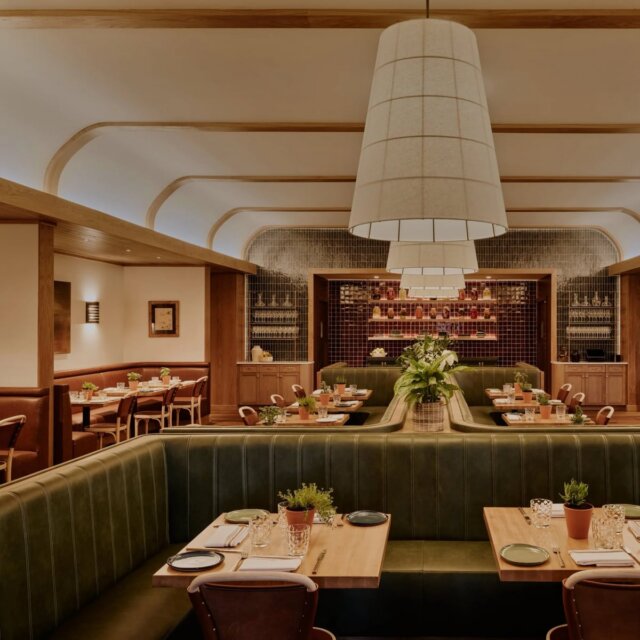
FictionWorks turned a flat, open-plan restaurant into a run of moody connected rooms, with a stained-glass wine punt as the showpiece and a smart budget behind it.
Before it poured Napa reds under a vaulted ceiling, Napa Bistro Charlotte was a taco restaurant. That’s the starting point for FictionWorks, the design studio that turned the flat, open-plan space into one of the more convincing French-bistro-meets-wine-country rooms in the Southeast.
The restaurant, officially Napa Bistro and Wine Bar Stonecrest, takes its cue from the 1976 Paris Wine Tasting, the competition that changed how the world saw Californian wines. The brief: pair the look of a Parisian bistro with the quieter charm of a Napa Valley farmhouse. Co-founders Andrea De Camps and Olivia King wanted it to be “approachable enough for a casual weeknight dinner while offering the sense of occasion people look for when celebrating a great meal and a bottle of wine.”
One big box, several small rooms
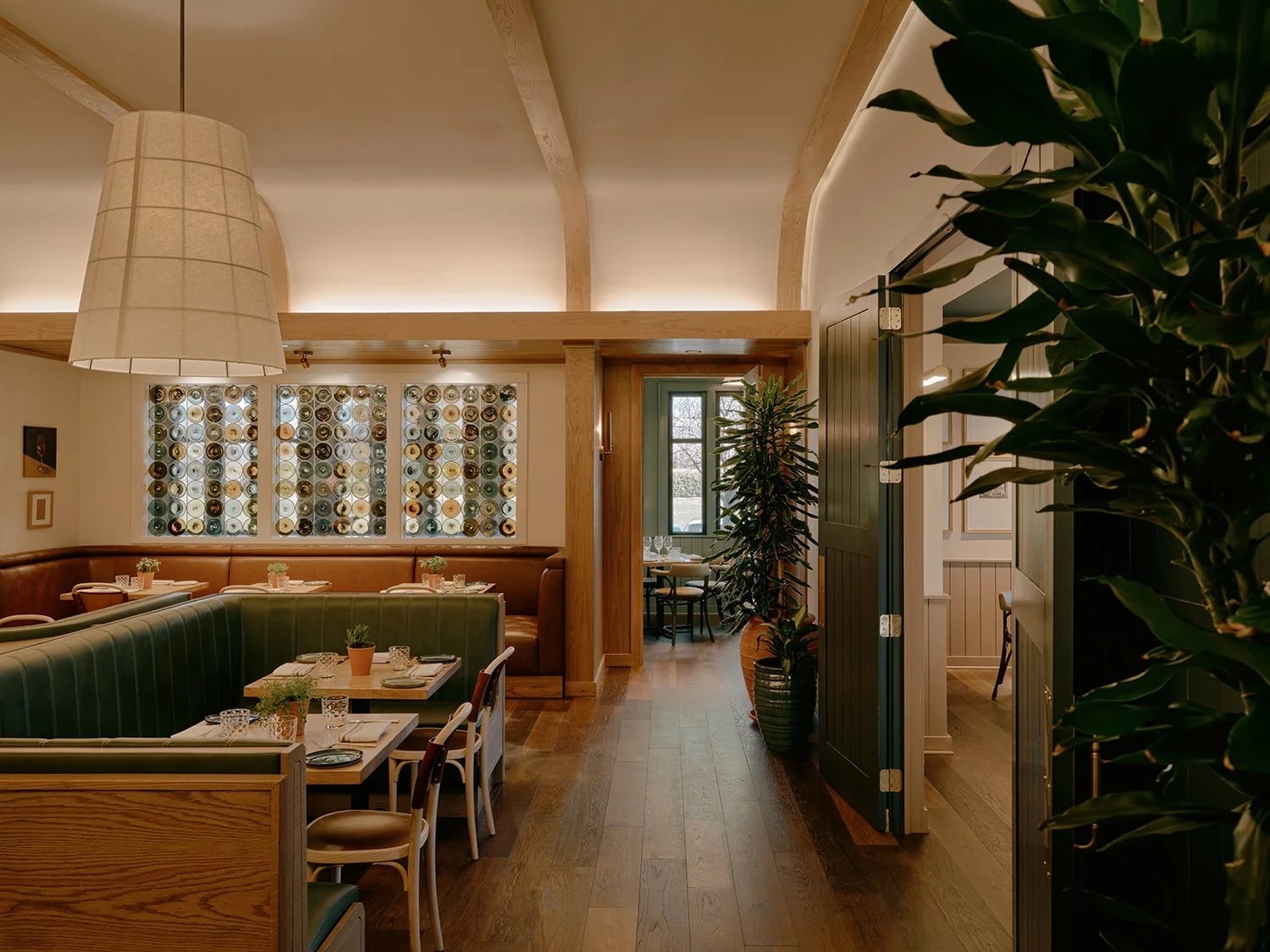
The layout does the heavy lifting. The space covers 6,500 square feet, with architecture by In Situ Studio, and it’s now organized as a string of connected rooms, each with its own personality. Walk through and the old open plan reads as a sequence, not a single hall. It feels closer to a farmhouse that grew room by room than to a converted restaurant.
Overhead, a curved, vaulted ceiling fitted with an acoustic system from Baswa Acoustics takes the edge off the clatter of a full dining room. It also sets a rhythm through the space. In the dining rooms themselves, seating areas are scaled down to feel intimate, upholstered in worn leather that looks like it has already hosted a few long dinners.
Where the money went
Working inside an existing structure was, by the team’s account, one of the project’s biggest hurdles. The renovation wrapped in under nine months and ran on a clear design hierarchy. FictionWorks spent on a few high-impact elements and economized elsewhere.
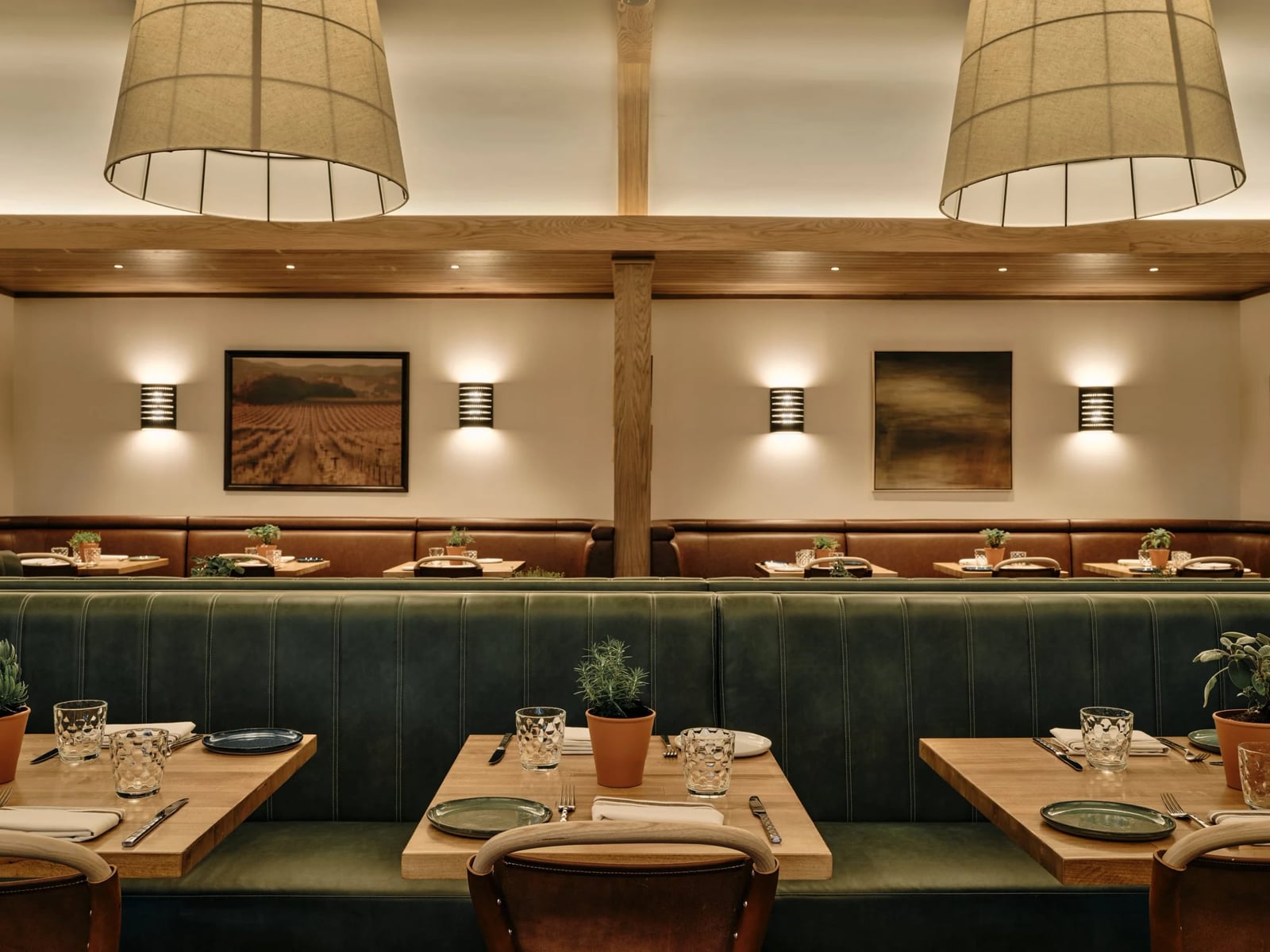
“We put the money into the details that would really make an impact—the stained-glass installation, custom lighting, and millwork,” the team says, “and we stayed more practical with the secondary elements—the tabletops, mosaic flooring, thrifted artwork, and accessories.”
The stained glass is the headline act. Built from hand-blown rondels, it nods to 1970s glasswork and takes the shape of a wine bottle punt, that dimple in the base of the bottle. Around it, custom lighting does its own work: linen pendants and sculptural chandeliers are placed to play off natural light and carve out moody little vignettes.
The floor, meanwhile, is the budget-smart move that still looks deliberate. Classic black-and-white tiles from Daltile’s Keystone collection form a mosaic pattern that contrasts sharply with the more natural materials around it.
A palette that tastes like the cellar
The colors pull from three places: the green of Napa’s vineyards, the warmth of 1970s interiors, and the polish of a Paris bistro. Deep greens and warm wood tones lead, with amber and bronze as accents. The studio’s aim was the richness of aged wine without a dated feel.
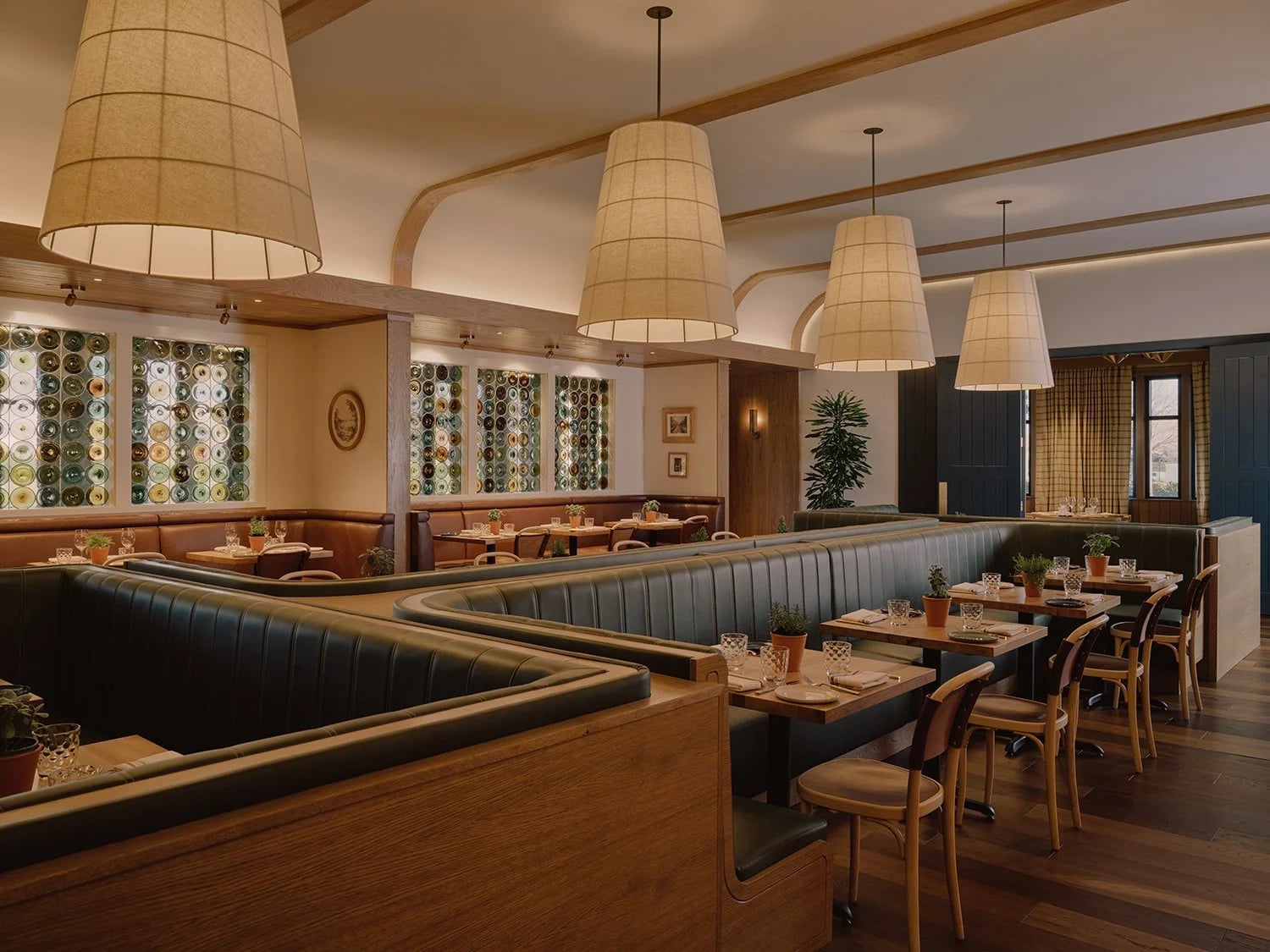
The art keeps the room tied to its address. Photographs and digital works by California artist Julia Crane hang alongside pieces by Charlotte-based creatives, so the Napa story gets a local counterpart. The thrifted artwork mentioned above is part of that mix of high and low.
Charlotte, one of the Southeast’s fastest-growing cities, isn’t short on new restaurants. What FictionWorks has done here is give one a reason to exist beyond the menu. The Paris Wine Tasting was a story about challenged expectations, and a former taco restaurant that now reads as a wine-country bistro fits that theme neatly. The team puts it this way: “The restaurant draws from this spirit of transformation, not to recreate history, but to honor and reimagine it.”
Photography by Pablo Enriquez.
Via Design Milk